Troja Palace
A red and white baroque villa with a staircase full of giants
- Area Troja
- Type Palace
- Time needed 1h 15m
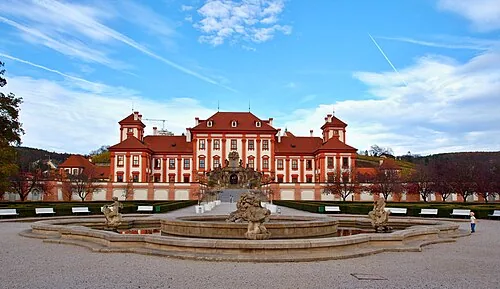
Troja Palace is a red and white baroque summer villa on the north bank of the Vltava, built between 1679 and 1691 for Count Václav Vojtěch of Šternberk to a design by Jean-Baptiste Mathey. Its signature is the double outdoor staircase on the garden front, crowded with over-lifesize stone figures of giants being hurled down by the gods. The palace now holds nineteenth-century Czech art for the Prague City Gallery, and its formal garden and vineyard run down towards the river.
Open in the planner →Getting there
Bus 112 from metro line C (red) at Nádraží Holešovice runs to the Zoologická zahrada stop; the palace gate is a couple of minutes from there, next door to the zoo. Door to door from Staroměstské náměstí is about forty minutes. In summer a river boat runs up to the Troja landing stage, from which it is a short flat walk. The site is largely level, though the palace is entered up steps and the staircase hall has no lift.
What you see
Approach from the garden side so you meet the staircase as it was meant to be met: two curving flights wrapping a terrace, with the Battle of the Gods and the Giants carved across the balustrades by the Heermann brothers, limbs and torsos spilling over the stonework. Inside, the sequence of rooms is modest until you reach the Grand Hall, which is the reason to come in — Abraham Godyn painted the whole volume, walls and ceiling, in illusionistic fresco celebrating the Habsburg victories over the Ottomans, with painted architecture that opens the room into imaginary galleries and figures that lean out over the cornice. The Chinese Room and the smaller cabinets carry further painted and stucco decoration. The upper rooms hold the gallery's nineteenth-century Czech paintings and sculpture, hung sparely. Outside, the garden is laid out as a French parterre with clipped box, gravel walks, fountains and orangery buildings, and the vineyard climbs the slope behind.
What to pair it with
Prague Zoo is immediately next door, and the Botanical Garden with its glasshouse sits on the hill above, so the three can be done together. Stromovka park is a walk south across the river.
When to go
The palace is seasonal — expect it to be closed through the winter months, and check before you go even in shoulder season. Late spring and early autumn are best, when the parterre is planted and the vineyard is in leaf. Mornings on weekdays are very quiet; weekends bring families spilling over from the zoo. The garden alone is worth the trip on a fine day, and the staircase photographs best in afternoon light from the south.
What is hard about it
The painted hall is the whole visit, and the rest of the interior is sparse — visitors who come expecting furnished state rooms find empty ones with pictures on the walls. Interpretation is limited and mostly Czech, so the iconography of the Godyn frescoes goes unexplained unless you read up first. It is closed for a long winter season, the journey is forty minutes each way for seventy-five minutes inside, and the palace is entered up steps with stairs between floors. On a hot day the garden offers little shade.
Common questions
How long do you need at Troja Palace?
Just over an hour for the interior and the garden. Longer if you combine it with the zoo or the Botanical Garden next door, which is the usual way to do it.
How do I get there from the centre?
Metro line C to Nádraží Holešovice, then bus 112 to the zoo stop; the palace is beside the zoo entrance. A river boat also runs in summer.
Is it open all year?
No. It closes for the winter season and hours vary at the edges of the year, so check before you go.