Břevnov Monastery
The oldest monastery in Bohemia, rebuilt in baroque around its spring
- Area Břevnov
- Type Church
- Time needed 1h 15m
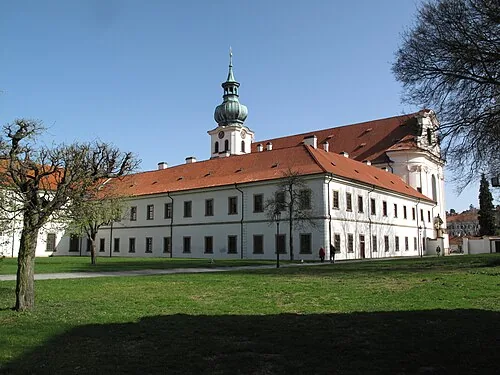
Břevnov Monastery was founded in 993 by Bishop Vojtěch and Duke Boleslav II, which makes it the oldest monastery in Bohemia, and it is still a working Benedictine house. The buildings you see are an early eighteenth-century rebuild by Christoph Dientzenhofer, wrapped around the spring that the foundation legend turns on. It is in Břevnov, west of the centre, and the church and the Romanesque crypt beneath it are shown only on guided tours.
Open in the planner →Getting there
Trams 22 and 25 run west from Malostranská and the castle district to the Břevnovský klášter stop, which is at the monastery wall — about thirty to thirty-five minutes from Staroměstské náměstí all in. From the stop it is a two-minute walk through the gate into the courtyard. The ground is gently sloped but there is no real climb; the crypt is reached by stairs.
What you see
The courtyard comes first, with the church of St Margaret on one side and the long prelature block on the other, and the whole composition is Dientzenhofer at his most restrained — curved gables, pilasters, grey and white. Inside the church, which you reach on a tour, the nave is a single space under a sequence of vaults with frescoes by Johann Jakob Steinfels in the ceilings, and the Baroque fittings and the organ case are intact. The tour then takes you down to the Romanesque crypt: a low, bare, eleventh-century space under the chancel, with the foundations of the earlier church, a stone floor and almost nothing added, and it is the best thing here by a distance. The prelature's Theresian Hall, with a painted ceiling, is included on some tours. Outside, the monastery garden runs away behind the buildings and is open separately — orchard, terraces, a small pavilion over the spring called Vojtěška, and a long view back at the church. There is a working brewery and a hotel in the precinct, and the garden is used by local people as a park.
What to pair it with
Hvězda and its walled wood are a few stops further west on the same tram line. Strahov Monastery and its library are back towards the castle on the same route, and Petřín can be reached from the same direction.
When to go
Tours of the church and crypt run on limited days, typically at set times at weekends, and that is the single thing to check before you go — the courtyard and garden are open far more widely than the interiors. Weekday visits often mean no interior access at all. Spring and early summer are best in the garden; the orchard terraces are good in autumn. Services take precedence over tours.
What is hard about it
If you arrive outside tour times you will see a courtyard, a closed church door and a garden, which is not much for a thirty-five minute tram ride. Tour times are few and are not always advertised reliably in English; booking or at least checking the day's schedule is sensible. The crypt involves stairs and is cool and damp. The precinct is not scenic in parts — there is a hotel, a car park and ordinary working buildings — and the surrounding district is residential and plain. Visitors expecting something on the scale of Strahov will find this quieter and smaller in effect, even though it is far older.
Common questions
How long do you need at Břevnov Monastery?
About an hour and a quarter with a tour of the church and crypt. Half an hour if you are only walking the courtyard and garden.
Can you go into the church on your own?
No. The church and the Romanesque crypt are shown on guided tours only, on limited days and at set times, so check before you go.
Is it really the oldest monastery in the country?
It is the oldest in Bohemia, founded in 993, though almost everything standing is an eighteenth-century rebuild. The Romanesque crypt is the main survival of the early phases.
Nearby
More of the same kind
- St. Vitus CathedralThe Gothic cathedral inside the castle, with the crown jewels and Mucha's window
- St. Nicholas Church (Malá Strana)The finest baroque church in the city, with a 70-metre dome
- Old New SynagogueThe oldest working synagogue in Europe, built around 1270
- Spanish SynagogueMoorish revival interior, every surface gilded and patterned