Kutná Hora
The medieval silver town, and the ossuary at Sedlec
- Area Kutná Hora
- Type Neighbourhood
- Time needed 3h
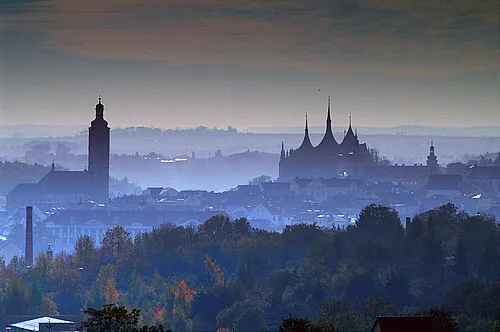
Kutná Hora was the second city of medieval Bohemia, rich from the silver mined under it and from the royal mint that struck the Prague groschen. It is about 70km east of Prague and the historic centre, together with the church and monastery at Sedlec, is on the UNESCO list. Treat it as a day rather than a stop: the sights are spread over two separate parts of town.
Open in the planner →Getting there
Fast trains run from Praha hlavní nádraží to Kutná Hora hlavní nádraží in around an hour. That station is not in the old town — it is out at Sedlec, which is convenient if you start with the ossuary. From there a small local shuttle train runs on to Kutná Hora město, five minutes from the historic centre, or you can take a town bus or walk the three kilometres. Door to door from the Old Town Square, reckon on something over two hours. Within the old town everything is walkable, but the ground rolls and the streets are cobbled.
What you see
Most people work through three things. St Barbara's Church, on the ridge at the edge of town, is the late Gothic cathedral the miners paid for, with net vaulting, a mining chapel painted with men at work underground, and the Smíšek chapel murals. The Italian Court, down in the centre, is the old royal mint and part-time royal residence: you are shown the minting workshops where coin blanks were hammered out, the chapel, and the audience hall painted in the nineteenth century with scenes from the town's history. Then the Sedlec ossuary, a separate site out near the main station, where the bones of tens of thousands of people cleared from the abbey graveyard were arranged into a chandelier, pyramids, a coat of arms and chalices by a woodcarver named Rint in 1870; it now requires timed tickets booked ahead and photography is no longer permitted inside. Beyond those, the Hrádek houses a silver mining museum with a guided walk through a medieval tunnel, the Stone House has a carved late Gothic gable, and the Cathedral of the Assumption at Sedlec, remodelled by Santini, stands a short walk from the ossuary.
What to pair it with
The three main sights pair with each other rather than with anything in Prague — St Barbara's, the Italian Court and the Sedlec ossuary make one coherent day. If you have time left, the Hrádek mine tour and the Cathedral of the Assumption fill it.
When to go
Start early and do Sedlec first or last, depending on which direction your train runs — doubling back wastes the best part of an hour. Summer weekends and public holidays are the busiest, and the ossuary in particular gets congested in the middle of the day. Spring and autumn are more comfortable for a day that involves a lot of walking. Several sites close or shorten their hours in winter and on Mondays, so check before you go.
What is hard about it
The sights are not close together: the gap between the ossuary at Sedlec and the old town is a real journey, not a stroll, and misjudging it is the most common way to lose the day. The ossuary needs timed tickets booked in advance and bans photography, which disappoints a lot of people who came for exactly that. Tickets are sold site by site, with combined options whose coverage varies — work out what you actually want to see before buying. Add the fact that the shuttle train and the town buses are infrequent, and a Kutná Hora day can involve more waiting about than sightseeing.
Common questions
How long do you need in Kutná Hora?
A full day. Allow three hours for the three main sights themselves and the rest for travel, the transfers between the old town and Sedlec, and lunch.
Is the ossuary worth a separate trip?
Not on its own, given the journey. It takes twenty minutes to see and makes sense combined with St Barbara's and the Italian Court in one day.
Can you get there and back in a day from Prague?
Easily. Trains run through the day, the ride is about an hour each way, and most visitors leave Prague mid-morning and are back for the evening.
Nearby
More of the same kind
- JosefovThe former Jewish quarter: six synagogues and the old cemetery
- Malá StranaBaroque palaces and steep lanes between the bridge and the castle
- Nerudova StreetThe climb to the castle, lined with house signs from before street numbers
- Rašín EmbankmentThe riverside vaults and the Saturday farmers' market