Rašín Embankment
The riverside vaults and the Saturday farmers' market
- Area Nové Město
- Type Neighbourhood
- Time needed 45m
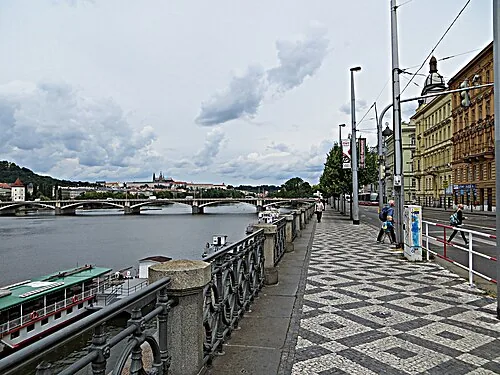
The run of arched vaults built into the Vltava embankment wall between Výtoň and the Dancing House, converted over the last decade into bars, cafes and small galleries, with a farmers' market along the quay on Saturday mornings. Locals call the strip the náplavka, and it is where the city drinks by the water in summer. Saturday is the day worth planning around; the rest of the week it is an evening place.
Open in the planner →Getting there
Tram 2, 3, 17 or 21 to Výtoň for the southern end, or to Jiráskovo náměstí for the northern end by the Dancing House. From Staroměstské náměstí it is about 15 minutes: walk to Národní divadlo and take a riverside tram one or two stops, or walk the whole way along the river in 25 minutes. Metro line B to Karlovo náměstí leaves a five-minute walk down to the water. The quay sits below street level: you drop down a ramp or a flight of steps from the embankment road, which is the only climb involved, and the quay itself is flat and long.
What you see
From the Výtoň end you walk north along the waterline with the embankment wall on your right, each vault a round-headed door with glass set into the arch. Some are bars with tables on the cobbles, some are coffee roasters or wine rooms, one or two are exhibition spaces; the mix changes from year to year. On Saturday the quay between the vaults is lined with market stalls — vegetables, cheese, bread, smoked fish, cider and flowers from Bohemian growers — and crowded shoulder to shoulder by mid-morning. Moored boats along the edge serve as floating bars. The view across the water is to Smíchov and the Petřín ridge, with the Dancing House and the Vyšehrad cliff closing the strip at either end. The cobbles are original and uneven throughout.
What to pair it with
The Dancing House stands at the northern end. Vyšehrad and the Vyšehrad Tunnel are at the southern end, and Výtoň is the natural start or finish for the walk.
When to go
Saturday morning for the farmers' market, which is the single best reason to come and is over by early afternoon. Otherwise come for the evening, from late afternoon until dark, when the bars fill and the light is on the Petřín side. It is strongly seasonal: spring to early autumn is when the quay is alive, and in winter much of it shuts or moves inside. The quay also closes at high water, so check if the river is up.
What is hard about it
Out of season and on a wet weekday it is a line of shuttered doors and nothing else. The market is popular with residents rather than staged for visitors, which is its merit, but it is genuinely crowded and prices are not cheap. Drinks on the quay cost more than in a back-street pub. The cobbles are rough underfoot and poorly lit in places, and there are few public toilets. When the Vltava floods, the whole strip is cleared without much notice.
Common questions
How long do you need at the Rašín Embankment?
Forty-five minutes to walk the strip and look into a few vaults; longer if you sit down. The Saturday market deserves an hour or more.
Which day is best?
Saturday morning, for the farmers' market along the quay. For bars and the evening crowd, Thursday to Saturday after work.
Is it free?
Yes, the quay and the market are free to walk through. You pay only for what you eat or drink.
Nearby
- Wenceslas SquareNot a square but a boulevard, and the stage for 1968 and 1989
- National TheatreThe gold-roofed theatre the Czechs paid for twice
- National MuseumThe neo-Renaissance pile at the top of Wenceslas Square
- Dancing HouseGehry and Milunic's curved pair on the embankment
- Lucerna PalaceAn arcade of 1920s glass and marble, with a horse hanging upside down
- Charles SquareThe largest square in the city, laid out by Charles IV and now a park
More of the same kind
- JosefovThe former Jewish quarter: six synagogues and the old cemetery
- Malá StranaBaroque palaces and steep lanes between the bridge and the castle
- Nerudova StreetThe climb to the castle, lined with house signs from before street numbers
- ŽižkovThe working-class hill district, still the city's drinking quarter
Part of these routes
- Vyšehrad and the riverThe quieter castle on its rock, the cemetery of the national revival, and the walk back along the embankment.
- Prague in five daysA fuller first visit: the Old Town, the castle, Malá Strana, the Jewish quarter and Vyšehrad.
- Prague at lengthEverything the other routes cover inside the city, spread over unhurried days with a castle at the end.