Prague astronomical clock
The 1410 clock on the Old Town Hall, with the apostles on the hour
- Area Staré Město
- Type Landmark
- Time needed 30m
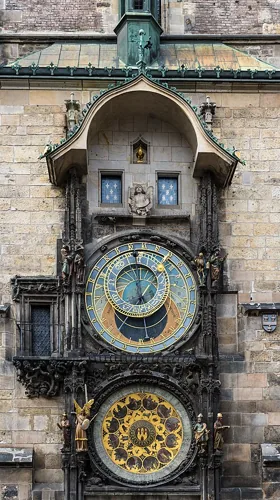
The astronomical clock is set into the south wall of the Old Town Hall on the Old Town Square, and its oldest parts date from 1410, which makes it the oldest working clock of its kind. The upper dial shows the position of the sun and moon in the zodiac and the hours in three different systems; the lower calendar dial is a nineteenth-century panel by Josef Mánes, now a copy. On the hour a small mechanical show runs: the apostles pass two windows, a skeleton rings a bell, and a cockerel crows.
Open in the planner →Getting there
It is on the Old Town Square, so you are almost certainly walking. Metro line A green to Staroměstská is a five minute walk, and from Můstek on lines A green and B yellow it is about the same. Tram 2, 17 or 18 to Staroměstská leaves you the same distance away along the river side. There is no climb to reach the clock; the Old Town Hall tower behind it has a lift as well as stairs, which is unusual among Prague towers.
What you see
Stand back far enough to take in the whole wall: the dials, the carved figures at the sides — Vanity with a mirror, a miser with a purse, Death with his hourglass, and a figure representing the Turk — and the gilded cockerel above the windows. Read the astronomical dial properly if you have the patience: the black outer ring of Arabic numerals is Old Bohemian time, counted from sunset, and the blue and brown fields mark day, dusk and night. The calendar dial below shows the twelve months as farming scenes. Then go inside and up the tower, which is the better half of the visit: the lift and the gallery give you the square from above with the Týn spires opposite, and the route in passes the Gothic chapel and the back of the apostle figures.
What to pair it with
The Old Town Square is immediately in front of you, and the Church of Our Lady before Týn faces it from the far side. The Clementinum and Charles Bridge are both within ten minutes to the west.
When to go
Any hour between about nine and nine brings the show and a crowd; the thinnest audiences are at the first and last hours of the day. For the clock face itself, morning light falls on the south wall and gives the best photographs. The square is at its worst at midday in summer and during the Christmas and Easter markets, when the space in front of the clock is reduced to a pen. The tower is worth timing for late afternoon.
What is hard about it
The hourly show lasts under a minute, the figures are small and high up, and most people come away thinking it was not worth the wait — that is the honest consensus, and it is better to know in advance. Twenty minutes before the hour a dense crowd forms, which is prime pickpocketing conditions, and at the back you will see very little. Much of what you are looking at is restored or replaced rather than original, including the apostle figures and the calendar panel. The tower is ticketed, and although there is a lift the top gallery is reached by steps and gets congested.
Common questions
How long do you need at the astronomical clock?
Ten minutes to look at the dials and catch the hourly show, or half an hour if you also go up the Old Town Hall tower. There is no need to arrive long in advance.
Is the astronomical clock show worth waiting for?
Not on its own. It runs for well under a minute, the moving figures are hard to see from the ground, and the clock face itself is more interesting than the performance.
Can you go inside the Old Town Hall?
Yes, and it is the better part of the visit. A ticket gets you the tower, which has a lift, plus the historic rooms and chapel; check current opening before you go.
Nearby
- Charles BridgeThirty baroque statues on a fourteenth-century stone bridge
- Old Town SquareThe medieval square the city turns around, ringed by gabled houses
- ClementinumA Jesuit college holding a baroque library hall and an astronomical tower
- Church of Our Lady before TýnThe twin black spires over the Old Town Square
- Powder TowerThe Gothic gate where the coronation route began
- Municipal HouseArt nouveau at full volume, with a concert hall inside
More of the same kind
- Wenceslas SquareNot a square but a boulevard, and the stage for 1968 and 1989
- Golden LaneA row of tiny cottages built into the castle wall
- Dancing HouseGehry and Milunic's curved pair on the embankment
- Lennon WallA graffiti wall repainted continuously since 1980
Part of these routes
- The Old TownThe square, the clock, the two towers and the cubist corner, all within ten minutes of each other.
- Prague in three daysThe short list, ordered so each day holds together and the river is crossed as little as possible.
- Prague in five daysA fuller first visit: the Old Town, the castle, Malá Strana, the Jewish quarter and Vyšehrad.
- Prague at lengthEverything the other routes cover inside the city, spread over unhurried days with a castle at the end.