Wenceslas Square
Not a square but a boulevard, and the stage for 1968 and 1989
- Area Nové Město
- Type Landmark
- Time needed 30m
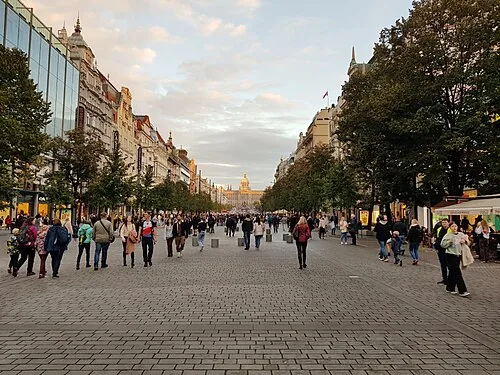
Wenceslas Square is not a square but a boulevard about 750 metres long, laid out as a horse market in the fourteenth century and now the commercial spine of Nové Město. It slopes up from the Old Town to the National Museum, and the top end is where Czechs gathered in 1968 and again in 1989. The statue of St Wenceslas on horseback at the top is the fixed point of both events.
Open in the planner →Getting there
The square has a metro station at each end. Můstek, where lines A green and B yellow cross, is at the bottom and is a two minute walk from the Old Town Square side; Muzeum, where lines A green and C red cross, is at the top beside the National Museum. From the Old Town Square it is a flat five to seven minute walk down 28. října and Na Příkopě. If you arrive at Muzeum you walk the square downhill, which is the easier direction.
What you see
Start at the top by the Myslbek equestrian statue of St Wenceslas, flanked by four Bohemian patron saints, with the National Museum's neo-Renaissance facade behind. A few metres in front of the statue, set into the pavement, is the small memorial to Jan Palach and Jan Zajíc, who burned themselves in protest after the 1968 invasion. Walking down, the architecture is the point: the Hotel Evropa's art nouveau front, the functionalist frontages of the 1930s and the Lucerna arcade off to the left, where David Černý's upside-down horse hangs in the atrium. The lower end narrows towards Můstek and the shopfronts become ordinary chains.
What to pair it with
The National Museum stands at the top of the square and the Lucerna arcade opens off its western side. The Old Town Square and the Powder Tower are both within ten minutes on foot at the bottom end.
When to go
Morning is best if you want the memorials and the facades without much noise; the square is a working street and busiest in the late afternoon and the shopping hours. At night the lower half has a seedy edge of casinos, strip clubs and touts, and is not where to linger. Christmas and Easter bring market stalls to the upper end, and political demonstrations still use the space in front of the museum, which is worth knowing if you find it fenced off.
What is hard about it
As a sight it underdelivers on arrival: it is a wide commercial street with trams of traffic along the sides, fast food and souvenir shops, and nothing much to look at unless you know what happened here. The pavements are wide but uneven in places and there is heavy traffic at both ends. The lower stretch has a persistent problem with touts, overpriced currency exchange and aggressive club promoters, worst at night. There is no single building to go inside, so without some history to hang it on the visit is a walk and nothing more.
Common questions
How long do you need at Wenceslas Square?
Half an hour to walk it from the museum down to Můstek with stops at the statue and the Palach memorial. Longer only if you go into the Lucerna arcade or the National Museum.
Why is Wenceslas Square famous?
It was the main stage for the protests after the 1968 Soviet invasion and for the mass demonstrations of the 1989 Velvet Revolution. The memorial in front of the St Wenceslas statue marks Jan Palach's self-immolation.
Is Wenceslas Square safe at night?
It is policed and busy, but the lower end attracts touts, pickpockets and clip joints after dark. Keep your bag in front of you and ignore anyone offering a club or a currency rate.
Nearby
- National TheatreThe gold-roofed theatre the Czechs paid for twice
- National MuseumThe neo-Renaissance pile at the top of Wenceslas Square
- Dancing HouseGehry and Milunic's curved pair on the embankment
- Lucerna PalaceAn arcade of 1920s glass and marble, with a horse hanging upside down
- Charles SquareThe largest square in the city, laid out by Charles IV and now a park
- Emmaus MonasteryA Gothic abbey given two concrete spires after the 1945 bombing
More of the same kind
- Charles BridgeThirty baroque statues on a fourteenth-century stone bridge
- Prague astronomical clockThe 1410 clock on the Old Town Hall, with the apostles on the hour
- Old Town SquareThe medieval square the city turns around, ringed by gabled houses
- Golden LaneA row of tiny cottages built into the castle wall
Part of these routes
- The New TownCharles IV's fourteenth-century extension, the 1989 boulevard and the arcade with the hanging horse.
- Prague in three daysThe short list, ordered so each day holds together and the river is crossed as little as possible.
- Prague in five daysA fuller first visit: the Old Town, the castle, Malá Strana, the Jewish quarter and Vyšehrad.
- Prague at lengthEverything the other routes cover inside the city, spread over unhurried days with a castle at the end.