Dancing House
Gehry and Milunic's curved pair on the embankment
- Area Nové Město
- Type Landmark
- Time needed 25m
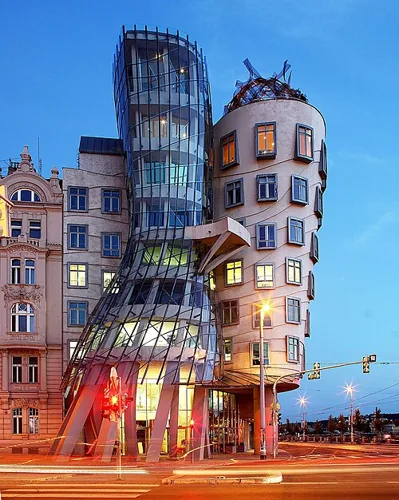
The Dancing House is an office building on the Vltava embankment at Jiráskovo náměstí, designed by Vlado Milunić with Frank Gehry and completed in 1996 on a corner site left empty by wartime bombing. Two forms lean together, a glass tower pinched at the waist against a curved concrete block, and the pair picked up the nickname Fred and Ginger. It is a working building, so there is nothing to tour: you look at it from outside, and the only interiors open to the public are a ticketed gallery and a rooftop bar.
Open in the planner →Getting there
Tram 17 along the embankment stops at Jiráskovo náměstí, right in front of it, about ten minutes from the Old Town stops. Metro Karlovo náměstí on the B yellow line is a seven-minute walk west along Resslova, and metro Národní třída on the B line is a similar distance north. From Staroměstské náměstí it is a flat twenty to twenty-five minutes down Národní and along the river. The pavement around it is level and there is a lift inside for the rooftop.
What you see
The thing to do is walk round it, because the two volumes read completely differently from each angle: from the bridge approach at Jiráskův most the glass tower appears to twist and lean into its partner, while from upstream along Rašínovo nábřeží the undulating window grid of the concrete block dominates and the tower disappears behind it. A metal openwork dome sits on top of the glass tower. Cross to the Smíchov bank for the full composition with the castle and Petřín behind it, which is the view most photographs take. The gallery on the lower floors shows changing exhibitions and is the cheap way to get inside. The rooftop bar and terrace, reached by lift, give a view upriver towards Charles Bridge and down on the embankment; both the gallery and the bar are ticketed or charged separately from each other, and neither takes you into the offices.
What to pair it with
The Vltava embankment walk and the Náplavka riverside are directly alongside. Vyšehrad is twenty-five minutes upstream, and Wenceslas Square and the National Museum are a short walk inland.
When to go
Late afternoon and the first half hour after sunset show the glass tower best, when the light is on the river side and the interior lighting starts to read through the facade. The pavement in front is narrow and gets congested at midday with coach groups stopping for ten minutes. Winter is as good as summer for the exterior. The rooftop is weather-dependent and worth a check before you go, as it closes for private events.
What is hard about it
This is a five to ten minute stop and visitors routinely report feeling let down, having expected an attraction; the building is smaller in person than photographs suggest and sits on a busy road junction with traffic noise. There is no admission to the building as a building. The rooftop bar is expensive for what it is and requires booking at busy times, the gallery is modest, and the queue for the single lift can be long. The best views are from the opposite bank, which adds a bridge crossing to the stop.
Common questions
How long do you need at the Dancing House?
Twenty-five minutes, including walking round it and crossing the bridge for the view back. Add an hour if you intend to go up to the rooftop or into the gallery.
Can you go inside the Dancing House?
Only into the gallery and the rooftop bar and terrace, each ticketed or charged separately. The rest of the building is private offices and a hotel.
Why is it called Fred and Ginger?
The nickname compares the two leaning forms to a dancing couple, Fred Astaire and Ginger Rogers. The architects did not use the name themselves and it is less common in Czech.
Nearby
- Wenceslas SquareNot a square but a boulevard, and the stage for 1968 and 1989
- National TheatreThe gold-roofed theatre the Czechs paid for twice
- National MuseumThe neo-Renaissance pile at the top of Wenceslas Square
- Lucerna PalaceAn arcade of 1920s glass and marble, with a horse hanging upside down
- Charles SquareThe largest square in the city, laid out by Charles IV and now a park
- Emmaus MonasteryA Gothic abbey given two concrete spires after the 1945 bombing
More of the same kind
- Charles BridgeThirty baroque statues on a fourteenth-century stone bridge
- Prague astronomical clockThe 1410 clock on the Old Town Hall, with the apostles on the hour
- Old Town SquareThe medieval square the city turns around, ringed by gabled houses
- Golden LaneA row of tiny cottages built into the castle wall
Part of these routes
- The New TownCharles IV's fourteenth-century extension, the 1989 boulevard and the arcade with the hanging horse.
- The twentieth centuryCubism, functionalism, a Loos villa and a television tower: a century of arguments in buildings.
- Prague in five daysA fuller first visit: the Old Town, the castle, Malá Strana, the Jewish quarter and Vyšehrad.
- Prague at lengthEverything the other routes cover inside the city, spread over unhurried days with a castle at the end.