Rudolfinum
The neo-Renaissance concert hall on the river, home of the Czech Philharmonic
- Area Josefov
- Type Theatre
- Time needed 1h
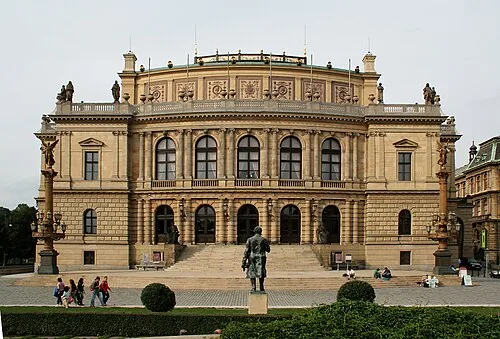
The Rudolfinum is the neo-Renaissance concert hall on the Vltava embankment in Josefov, opened in 1885 and now the home of the Czech Philharmonic. Its main auditorium, Dvořák Hall, is one of the oldest purpose-built concert halls in Europe still in nightly use. The building also houses Galerie Rudolfinum, a contemporary art space in the former gallery wing. Between the two, there is usually something open, but the hall itself is seen properly only at a concert.
Open in the planner →Getting there
Tram 17 or 18 to Staroměstská, which is also the Staroměstská metro station on line A (green); the tram stop and the building face each other across náměstí Jana Palacha. From Staroměstské náměstí it is a flat walk of about eight minutes west along Kaprova. There is no climb; the main entrance is up a short flight of steps from the square, with level access at the side for the gallery.
What you see
From outside, the point is the river front: a long arcaded facade on the embankment with the roofline statues of composers looking out over the water towards the Castle. Inside, the vestibule and the stone staircase set the tone, all marble and coffered ceiling. Dvořák Hall is the reason to come — a rectangular shoebox hall with a gallery running round three sides, an organ at the back of the platform and painted panels overhead; sit anywhere and the sound is direct and dry rather than cushioned. The smaller Suk Hall is used for chamber recitals and recordings. The gallery wing, reached from the Alšovo nábřeží side, runs changing exhibitions in a set of high, plain, top-lit rooms with no permanent collection, so what you see depends entirely on the show that is up.
What to pair it with
The Convent of Saint Agnes is a ten-minute walk north through Josefov. The Old Jewish Cemetery and the Old-New Synagogue are immediately behind the building, and Charles Bridge is a few minutes downstream along the embankment.
When to go
Mornings are quiet outside and the river facade takes the light from the east, so photographs work early. The gallery is busiest at weekend afternoons. Concerts are mostly in the evening, the season runs roughly autumn to late spring, and popular programmes sell out weeks ahead, so book online well before you travel; check before you go, because summer brings a thinner schedule aimed at visitors. Daytime guided access to the halls happens only on some days and is worth checking in advance rather than turning up for.
What is hard about it
You cannot normally wander into Dvořák Hall just to look. Without a concert ticket or a scheduled tour, a visit is the exterior plus whatever temporary exhibition is on, and people who came for the famous interior leave disappointed. The gallery has no collection of its own, so a show you have no interest in means nothing to see. Seats in the upper gallery are tight and the sightlines to the platform are partly blocked at the sides. Cloakroom use is expected at concerts and there are queues at the interval.
Common questions
How long do you need at the Rudolfinum?
About an hour for the exterior and a gallery show. A concert is a full evening, usually two hours with an interval.
Can you go inside without a concert ticket?
Only into the gallery wing, or on one of the occasional guided openings of the halls. The auditorium is not a daytime walk-in attraction.
Is it worth hearing the Czech Philharmonic here rather than elsewhere?
Yes, if the programme suits you — this is the orchestra's own hall and it sounds better here than in the larger municipal venues. Book early, as the best-value seats go first.
Nearby
- Old New SynagogueThe oldest working synagogue in Europe, built around 1270
- Spanish SynagogueMoorish revival interior, every surface gilded and patterned
- JosefovThe former Jewish quarter: six synagogues and the old cemetery
- Museum of Decorative ArtsGlass, furniture and posters, in a building as good as its contents
More of the same kind
- National TheatreThe gold-roofed theatre the Czechs paid for twice
- Estates TheatreWhere Mozart conducted the premiere of Don Giovanni in 1787
Part of these routes
- The Jewish QuarterSix synagogues, the oldest working one in Europe, and a museum of glass and posters beside them.
- Theatres and concert hallsWhere Don Giovanni opened, where the Philharmonic plays, and the theatre the nation paid for twice.
- Prague in five daysA fuller first visit: the Old Town, the castle, Malá Strana, the Jewish quarter and Vyšehrad.
- Prague at lengthEverything the other routes cover inside the city, spread over unhurried days with a castle at the end.