Museum of Decorative Arts
Glass, furniture and posters, in a building as good as its contents
- Area Josefov
- Type Museum
- Time needed 1h 30m
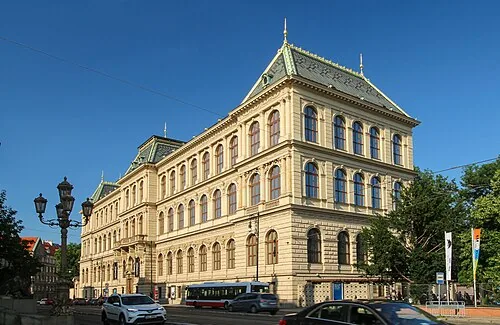
The Museum of Decorative Arts, or UPM, holds Czech glass, furniture, ceramics, posters, textiles, clocks and photography in a purpose-built palace of 1900 on 17. listopadu in Josefov, directly beside the Rudolfinum and facing the wall of the Old Jewish Cemetery. It is the national collection of applied art, and it reopened in 2017 after a long closure for rebuilding. People come for the glass and for the Czech design of the 1900s to 1930s, which is where the collection is strongest.
Open in the planner →Getting there
Metro A (green) to Staroměstská, then two minutes on foot: come out towards the Rudolfinum and the museum is the next building, on the corner. Trams 17 and 18 stop at Staroměstská on the embankment below. From Staroměstské náměstí it is a walk of six to eight minutes north-west along Kaprova. No climb, and the entrance is at street level.
What you see
The staircase hall comes first and is worth standing in before you look at anything else: coloured glass, marble and a painted ceiling, restored in the rebuild. The permanent displays then run by material rather than by period. Bohemian and Czech glass is the core — cut and engraved Baroque pieces, nineteenth-century coloured and cased glass, and the cleaner shapes of the twentieth century. There are rooms of ceramics and porcelain, metalwork and goldsmiths' work, clocks and watches, and furniture that takes you through Biedermeier into Czech Cubism and functionalism, a sequence you will not see assembled this well anywhere else. Graphic design, posters and bookbinding occupy their own section, and the photography holdings appear in changing displays. The ground-floor temporary exhibition halls are used hard, so there is usually a show running alongside the permanent collection.
What to pair it with
The Old Jewish Cemetery and the Jewish Museum sites are across the street. The Rudolfinum is next door, and the Spanish Synagogue and Staroměstské náměstí are both a short walk away.
When to go
Weekday mornings are quietest. The museum is shut one day a week, as Czech museums generally are, so check before you go. It is an indoor visit, which makes it a sound choice for rain or for the hottest part of a summer afternoon. Late winter afternoons are dim in the upper rooms, though the lighting is artificial throughout, so the season matters less here than at most Prague sights.
What is hard about it
The labelling is thorough in Czech and thinner in English in places, and the arrangement by material means the history is not told as a single story — you have to assemble it yourself. The glass is excellent but there is a great deal of it, and visitors who are not interested in decorative art find the hour and a half long. Not all floors are open at all times, because parts are given over to temporary exhibitions and occasionally closed between them. Lift access exists but the building is a nineteenth-century palace and some routes between rooms involve short flights of steps.
Common questions
How long do you need at the Museum of Decorative Arts?
About an hour and a half covers the permanent collection at a steady pace. Add half an hour if there is a temporary exhibition you want to see properly.
Is it the same thing as the Jewish Museum?
No. They are separate institutions that happen to stand opposite each other on 17. listopadu, and they need separate tickets.
Is it good for children?
Only moderately. There is a lot of glass behind glass and little to handle, so younger children tire quickly.
Nearby
- Old New SynagogueThe oldest working synagogue in Europe, built around 1270
- Spanish SynagogueMoorish revival interior, every surface gilded and patterned
- JosefovThe former Jewish quarter: six synagogues and the old cemetery
- RudolfinumThe neo-Renaissance concert hall on the river, home of the Czech Philharmonic
More of the same kind
- National MuseumThe neo-Renaissance pile at the top of Wenceslas Square
- Villa MüllerAdolf Loos's 1930 house, an argument about space made in concrete
- Trade Fair PalaceFunctionalist hall holding the national modern art collection
- Convent of Saint AgnesThe oldest Gothic building in Prague, now medieval art
Part of these routes
- The Jewish QuarterSix synagogues, the oldest working one in Europe, and a museum of glass and posters beside them.
- Prague in five daysA fuller first visit: the Old Town, the castle, Malá Strana, the Jewish quarter and Vyšehrad.
- Prague at lengthEverything the other routes cover inside the city, spread over unhurried days with a castle at the end.