Vyšehrad
The other castle, on a rock south of the centre, quiet and free to walk
- Area Vyšehrad
- Type Castle
- Time needed 1h 30m
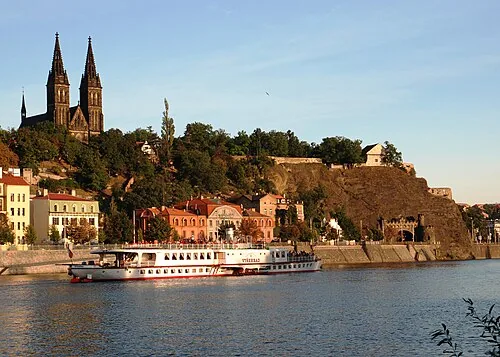
Vyšehrad is the other castle: a walled fort on a rock above the Vltava about three kilometres south of the centre, with a church, a cemetery, a Romanesque rotunda and a long rampart walk. The grounds are free to enter and open late, and almost nobody comes here on a coach. It is the one major Prague site where you can sit on a wall in silence and look at the whole city.
Open in the planner →Getting there
Metro line C red to Vyšehrad, which is a single stop from the main railway station and about ten to twelve minutes from the Old Town Square once you reach Muzeum. From the station exit, walk past the Congress Centre and through the Tábor Gate; the approach is level, which is the trick of arriving this way — the metro station is already on top of the rock. The alternative is tram 7, 18 or 24 to Albertov or Ostrčilovo náměstí and a stiff walk up through the Brick Gate or the brick steps on the river side.
What you see
Through the gates you come to the Rotunda of St Martin, a plain round eleventh-century chapel and one of the oldest buildings standing in Prague. The Basilica of St Peter and Paul follows, with its two neo-Gothic spires added in the 1900s and a painted interior that is far more decorated than the exterior suggests. Beside it is Vyšehrad Cemetery, where the Czech national revival buried its composers and writers around the Slavín vault; Dvořák, Smetana and Mucha are here and the graves are signposted. Then take the ramparts: the path runs around the southern and western walls past the Devil's Column and the Myslbek statue groups to the viewpoint over the river, with the bridges, the castle and the Dancing House in one line. The casemates, a tunnel inside the walls leading to the Gorlice hall where several original Charles Bridge statues are kept, are entered on a guided visit at set times.
What to pair it with
Vyšehrad Cemetery is inside the walls, and the Vyšehrad Tunnel sits under the cliff at the river end of the hill. The Rašín Embankment with its riverside vaults is a fifteen minute walk north along the water, and the Dancing House is beyond that.
When to go
Late afternoon into sunset is the reason to come: the view faces west and north over the river, and the ramparts catch the last of the light. The grounds stay open well past the buildings' closing time. Weekends bring local families and picnics rather than tourists, which is a different kind of busy and not unpleasant. Spring and autumn are best; in high summer the lawns fill up, and in winter the exposed walls are very cold. The site is large and the lawns are a genuine park, so bad weather leaves you with little shelter.
What is hard about it
The individual buildings are modest — the basilica is nineteenth-century work on an older shell, and anyone expecting a castle in the sense of Prague Castle will find mostly walls, lawns and gates. The paid parts, the casemates and the Gothic cellar exhibition, run on limited hours and the casemates are only accessible with a guide, so arriving late means seeing the free parts only. It is a thirty to forty minute round trip from the centre before you start, and the walk-up routes from the river are steep and slippery in wet weather. Food and drink options on the hill are few and basic.
Common questions
How long do you need at Vyšehrad?
An hour and a half covers the rotunda, the basilica, the cemetery and the full rampart walk. Add half an hour if you join a casemates visit.
Is Vyšehrad free?
The grounds, the ramparts, the cemetery and the parkland are free to enter. The casemates and the small exhibitions inside the walls are ticketed and keep shorter hours, so check before you go.
Is Vyšehrad worth visiting?
Yes, if you want views and quiet rather than interiors. It is the best place in Prague to see the city without a crowd, but the buildings themselves are plainer than the ones in the centre.
Nearby
- Vyšehrad CemeteryWhere the Czech national revival buried its composers and writers
- Vyšehrad TunnelA short rock tunnel under the Vyšehrad cliff, cut in 1905
More of the same kind
- Prague CastleThe largest ancient castle complex in the world, on the ridge above the river
- Konopiště CastleFranz Ferdinand's castle, and the hunting trophies of a man who shot everything
- Český Šternberk CastleA Gothic castle on a ridge above the Sázava, held by one family since 1241
- Křivoklát CastleA royal hunting castle deep in the forest west of the city
Part of these routes
- Vyšehrad and the riverThe quieter castle on its rock, the cemetery of the national revival, and the walk back along the embankment.
- Prague in five daysA fuller first visit: the Old Town, the castle, Malá Strana, the Jewish quarter and Vyšehrad.
- Prague at lengthEverything the other routes cover inside the city, spread over unhurried days with a castle at the end.