Vyšehrad Cemetery
Where the Czech national revival buried its composers and writers
- Area Vyšehrad
- Type Memorial
- Time needed 1h
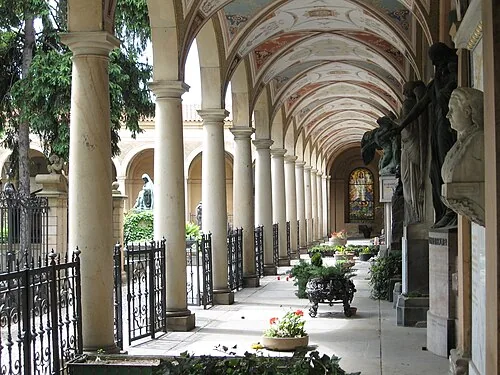
The cemetery at Vyšehrad, beside the Basilica of St Peter and St Paul on the rock above the Vltava south of the centre, was laid out in the 1870s as a burial ground for the leading figures of the Czech national revival. Antonín Dvořák, Bedřich Smetana, Karel Čapek and Alfons Mucha are all buried here, along with several hundred other writers, painters, scientists and performers. It is free to enter, and it is a quiet twenty minutes' walk from the nearest metro.
Open in the planner →Getting there
Metro line C (red) to Vyšehrad, which takes about ten minutes from the centre; from the station walk west past the congress centre and in through the Tábor Gate and the Leopold Gate, roughly ten minutes on level ground. Alternatively trams 2, 3, 7, 17 and 21 stop at Výtoň by the river and you climb the path up the rock, which is steep and takes a quarter of an hour. From Staroměstské náměstí allow half an hour either way. Inside the fortress the ground is flat; the cemetery itself is gravel paths.
What you see
Enter from the basilica side and the arcades run along two walls, a neo-Renaissance colonnade of family vaults with sculpted portraits and reliefs. The centrepiece at the far end is Slavín, the common tomb of 1893 under a winged figure, holding more than fifty people including Mucha; the names are cut into the stone on both sides. Dvořák's grave is in the arcade near the entrance, a bronze bust against a mosaic; Smetana's is a plain obelisk in the open ground, and Čapek lies under a modest flat stone. Walk the paths slowly and read the monuments as sculpture rather than as graves — the period between the 1880s and the 1930s produced some very good Czech memorial work here, including figures by Myslbek and Štursa. Behind and above, the basilica's twin spires close the view, and the fortress ramparts a minute away give the long prospect down the river.
What to pair it with
The Basilica of St Peter and St Paul is immediately beside the cemetery, and the rest of the Vyšehrad fortress — the casemates, the Rotunda of St Martin and the ramparts — surrounds it. The Dancing House is a walk north along the embankment.
When to go
Morning on a weekday is close to deserted. The cemetery closes earlier than the fortress grounds, and earlier still in winter, so do not leave it to late afternoon — check closing before you go. Autumn suits it: low light through the arcades and leaves on the gravel. All Souls at the start of November brings Czech families with candles, which is the one time it is genuinely busy and also the most interesting time to see it.
What is hard about it
It is small, and if you do not know who these people are it is twenty minutes of handsome stonework and nothing more; the information on site is thin and largely in Czech. The walk in from the metro is longer than people expect, and the alternative route up from the river is a stiff climb. Inscriptions are weathered in places and some graves are hard to find without the plan at the gate. It closes before dusk, and photography of individual graves is expected to be discreet.
Common questions
How long do you need at Vyšehrad Cemetery?
Half an hour to find the main graves and walk the arcades, an hour if you are reading the monuments properly. Add an hour or more for the rest of the fortress.
Is there an entrance fee?
No. The cemetery is free to enter, as are the fortress grounds; only the casemates and the gallery charge.
Who is buried there?
Dvořák, Smetana, Karel Čapek and Alfons Mucha among several hundred figures of Czech arts and science, with Mucha in the Slavín collective tomb.
Nearby
- VyšehradThe other castle, on a rock south of the centre, quiet and free to walk
- Vyšehrad TunnelA short rock tunnel under the Vyšehrad cliff, cut in 1905
More of the same kind
- National Monument at VítkovA granite slab on a ridge, with the largest equestrian bronze in the world
- Olšany CemeteryTwo million burials in a walled park, including Jan Palach
- TerezínThe fortress town the Nazis used as a ghetto and a transit camp
Part of these routes
- Vyšehrad and the riverThe quieter castle on its rock, the cemetery of the national revival, and the walk back along the embankment.
- Prague in five daysA fuller first visit: the Old Town, the castle, Malá Strana, the Jewish quarter and Vyšehrad.
- Prague at lengthEverything the other routes cover inside the city, spread over unhurried days with a castle at the end.