Vyšehrad Tunnel
A short rock tunnel under the Vyšehrad cliff, cut in 1905
- Area Vyšehrad
- Type Landmark
- Time needed 20m
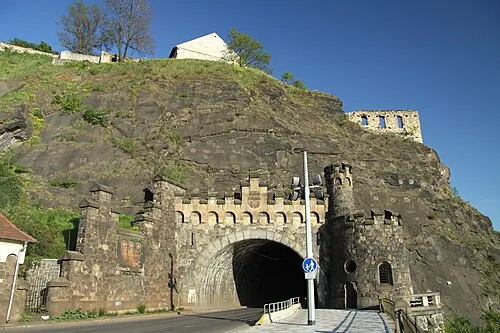
A short road tunnel cut through the rock under the Vyšehrad cliff in 1905, carrying the riverside road and the tram line beneath the fortress. It is about a hundred metres of blasted stone with portals at either end, and you walk through it in a couple of minutes. People come because it is the most direct way between the Výtoň riverside and the Podolí side, and because the cliff above it is the rock Prague's founding legend is attached to.
Open in the planner →Getting there
Tram 2, 3, 17 or 21 along the embankment to Výtoň puts you at the northern portal; the same routes carry on through the tunnel itself, so you can ride it rather than walk it. From Staroměstské náměstí it is roughly 20 minutes by tram, changing to a riverside route at Karlovo náměstí or Národní divadlo. On foot it is about 35 minutes south along the Vltava. There is no climb at tunnel level: the pavement is flat and continuous, though narrow. If you want the cliff top at Vyšehrad afterwards, the stepped path up from Vratislavova street is a steady five to ten minute climb.
What you see
From the northern portal you see the cut face of the Vyšehrad rock, with the fortress wall and the spires of the Basilica of St Peter and St Paul standing directly above it. Inside, the tunnel is lined and lit, with a pavement to one side and trams passing close; the sound is the main impression. At the southern end the road opens towards Podolí and the river widens. Looking back from there gives the best single view of the cliff, the tunnel mouth and the church towers stacked on top of one another. Immediately north of the portal is the railway bridge across the Vltava, which has its own walkway.
What to pair it with
Vyšehrad itself, directly above, is the obvious pairing. The Rašín Embankment vaults are a short walk north along the river, and the Dancing House sits beyond them.
When to go
Any time of day; it is a public road, always open. Morning light catches the cliff above the northern portal, late afternoon favours the view back from the Podolí side. Weekday rush hours bring heavier traffic and more noise. It is a reasonable place to be in rain, being one of the few covered walks on the riverside.
What is hard about it
This is a few minutes of your day, not a visit. It is a working road tunnel: traffic noise is loud, the pavement is narrow and the air is not pleasant when a queue of cars is standing. There is nothing to look at inside beyond the stonework and the lighting, and anyone expecting a monument will be disappointed. Treat it as a link between Vyšehrad and the embankment rather than a destination.
Common questions
How long do you need at the Vyšehrad Tunnel?
Five minutes to walk through and look back at the cliff. It works as a two-minute stop on the way to or from Vyšehrad, not as a stop in its own right.
Can you walk through it?
Yes, there is a pavement the whole way, but it is narrow and shared with passing trams and cars. Keep children close.
Is there anything to pay?
No. It is a public road, free to walk or ride through at any hour.
Nearby
- VyšehradThe other castle, on a rock south of the centre, quiet and free to walk
- Vyšehrad CemeteryWhere the Czech national revival buried its composers and writers
More of the same kind
- Charles BridgeThirty baroque statues on a fourteenth-century stone bridge
- Wenceslas SquareNot a square but a boulevard, and the stage for 1968 and 1989
- Prague astronomical clockThe 1410 clock on the Old Town Hall, with the apostles on the hour
- Old Town SquareThe medieval square the city turns around, ringed by gabled houses
Part of these routes
- Vyšehrad and the riverThe quieter castle on its rock, the cemetery of the national revival, and the walk back along the embankment.
- Prague in five daysA fuller first visit: the Old Town, the castle, Malá Strana, the Jewish quarter and Vyšehrad.
- Prague at lengthEverything the other routes cover inside the city, spread over unhurried days with a castle at the end.