Museum Kampa
Central European modern art in a converted mill on the island
- Area Malá Strana
- Type Museum
- Time needed 1h 15m
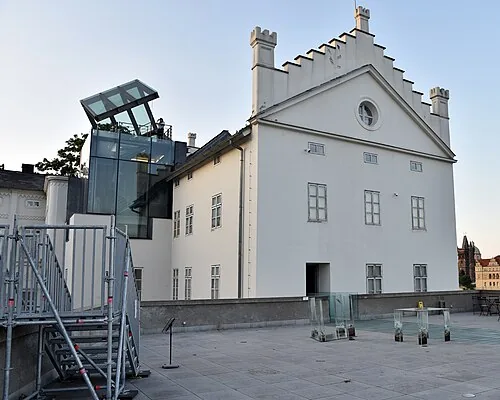
A museum of central European modern art in the converted Sova's Mills on Kampa island in Malá Strana, opened in 2003 on the collection assembled in exile by Meda Mládková and her husband Jan. The core is the largest public holding of František Kupka, a pioneer of abstract painting, together with the sculpture of Otto Gutfreund and work by artists suppressed under communism. It sits directly on the Vltava below Charles Bridge, with a terrace over the water.
Open in the planner →Getting there
Tram 12, 15, 20, 22 or 23 to Hellichova, then about five minutes down through Kampa; or metro line A to Malostranská and ten minutes south along the river. From Staroměstské náměstí it is about 15 minutes on foot: across Charles Bridge, then down the stairs from the bridge onto Kampa and south along the island. The approach is flat apart from those stairs, and the museum is step-free inside with a lift between floors. The entrance faces the island, not the river.
What you see
You come in past the glass and steel additions to the old mill — the yellow penguins standing in a row on the riverbank outside are hard to miss, and David Černý's oversized crawling babies sit on the lawn. Inside, the Kupka rooms are the heart of the museum: early figurative work and then the sequence of canvases through which he worked his way to pure abstraction before 1914, hung so that the progression reads in order. The Gutfreund rooms follow with cubist and later bronzes and plasters. Upper floors hold central and eastern European art of the later twentieth century from the Mládková collection, much of it made in private under censorship, and the temporary exhibition spaces. The mill structure is left visible in places — beams, the race, rough masonry against white walls. End on the terrace above the weir, which gives a low view of Charles Bridge and the castle ridge that you cannot get from the bridge itself.
What to pair it with
Kampa island and the Lennon Wall are immediately outside. Charles Bridge is at the northern end of the island, and the Vrtba Garden is a short walk up Karmelitská.
When to go
Mornings are quietest; the museum fills in the afternoon when Charles Bridge traffic spills onto the island. It is a sound choice for a wet day, being indoors and close to the centre. Late afternoon light on the terrace over the weir is the best of the day. The island floods in high water and the museum has closed for repairs after past floods, so check if the river is up. Opening days vary — check before you go.
What is hard about it
If you are not interested in abstraction, the Kupka rooms will not convert you, and several visitors find the collection narrow for the price. The permanent display is not large and can be seen in under an hour, which makes the ticket feel steep. Temporary exhibitions are sometimes charged separately or included depending on the show, so ask at the desk. Labelling in English is present but thin on the upper floors. The riverside position means closures when the Vltava is high.
Common questions
How long do you need at Museum Kampa?
About 75 minutes for the permanent collection and the terrace. Add half an hour if a temporary exhibition is on.
Is Museum Kampa worth visiting?
Yes if you want Kupka and twentieth-century Czech art, or an indoor hour close to Charles Bridge. It is not a general survey museum and is not for everyone.
Are the yellow penguins and the babies part of the museum?
They stand on the riverbank and lawn outside and are free to look at without a ticket. The babies are by David Černý, who also made the ones on the Žižkov television tower.
Nearby
- Petřín Lookout TowerA sixty-metre iron lookout on the hill, built for the 1891 exhibition
- St. Nicholas Church (Malá Strana)The finest baroque church in the city, with a 70-metre dome
- Malá StranaBaroque palaces and steep lanes between the bridge and the castle
- PetřínThe wooded hill above Malá Strana, with orchards and a funicular
- Kampa IslandAn island under the Charles Bridge, with a mill wheel and a park
- Lennon WallA graffiti wall repainted continuously since 1980
More of the same kind
- National MuseumThe neo-Renaissance pile at the top of Wenceslas Square
- Villa MüllerAdolf Loos's 1930 house, an argument about space made in concrete
- Trade Fair PalaceFunctionalist hall holding the national modern art collection
- Convent of Saint AgnesThe oldest Gothic building in Prague, now medieval art