National Museum
The neo-Renaissance pile at the top of Wenceslas Square
- Area Nové Město
- Type Museum
- Time needed 2h
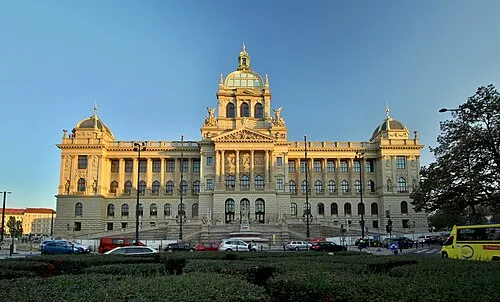
The National Museum fills the neo-Renaissance building that closes the top of Wenceslas Square, finished to Josef Schulz's design in 1891 and reopened in 2018 after a long reconstruction. It is the country's principal natural history and national history collection, and the building itself is half the reason to go in. A second, 1970s building next door, once the Federal Assembly, is part of the same museum and is linked underground.
Open in the planner →Getting there
Metro Muzeum sits directly beneath it, on both the A green line and the C red line, and the exit comes up at the foot of the steps. From Staroměstské náměstí it is about fifteen to twenty minutes on foot straight up Wenceslas Square, gently uphill the whole way, or two stops on the A line from Můstek. Trams 11 and 13 stop at I. P. Pavlova, five minutes away. There is a flight of outdoor steps to the main doors, with a lift entrance for step-free access.
What you see
The entrance hall and the grand staircase come first, with marble, allegorical painting and a glass dome overhead, and most people stop there before any exhibit. Up the stairs is the Pantheon, a domed hall of busts and statues of Czech scientists, writers and politicians, used for state occasions. The natural history floors hold mineralogy in long wooden cases, palaeontology with mounted skeletons, and zoology; a whale skeleton hangs in one of the halls. The prehistory and history galleries run through Bohemian archaeology and the modern Czech story, and a lift and passage take you under the road to the new building, which carries changing exhibitions and a view back at the old facade. Finish on the dome walkway if it is open, for a line straight down the square.
What to pair it with
Wenceslas Square itself runs from the door, and the Mucha Museum and the Old Town are within a short walk. The Dancing House is about twenty minutes down towards the river.
When to go
Mornings on weekdays are quietest. Weekend afternoons and the whole of any wet day bring school groups and families to the natural history floors in particular, and the staircase gets busy with photographs. Winter suits it, as it is an indoor visit of two hours or more; in summer the galleries are warm. Some days carry reduced or free admission and the museum sometimes opens late — check before you go.
What is hard about it
It is a large museum arranged conventionally, and the labelling is thinner in English than in Czech in parts of the natural history section; visitors expecting a modern interactive museum are sometimes disappointed. Tickets are sold for the historic building, the new building, or both together, and people regularly buy the wrong one. There is a lot of walking and stair-climbing between floors even with the lifts, and the dome walkway involves a narrow stair and can be shut without notice. Check opening arrangements before you go, as parts of the building close for events.
Common questions
How long do you need at the National Museum?
Two hours covers the staircase, the Pantheon and one or two collections at a steady pace. Allow three or more if you want both buildings and the temporary exhibitions.
Is it worth going in just for the building?
Yes, for many people the hall, staircase and Pantheon are the visit, and the cheapest ticket for the historic building gets you to all three.
Is it suitable for children?
The mineral and skeleton halls hold most children's attention well, and the museum runs family trails. The history galleries are text-heavy and less successful with younger visitors.
Nearby
- Wenceslas SquareNot a square but a boulevard, and the stage for 1968 and 1989
- National TheatreThe gold-roofed theatre the Czechs paid for twice
- Dancing HouseGehry and Milunic's curved pair on the embankment
- Lucerna PalaceAn arcade of 1920s glass and marble, with a horse hanging upside down
- Charles SquareThe largest square in the city, laid out by Charles IV and now a park
- Emmaus MonasteryA Gothic abbey given two concrete spires after the 1945 bombing
More of the same kind
- Villa MüllerAdolf Loos's 1930 house, an argument about space made in concrete
- Trade Fair PalaceFunctionalist hall holding the national modern art collection
- Convent of Saint AgnesThe oldest Gothic building in Prague, now medieval art
- Museum KampaCentral European modern art in a converted mill on the island
Part of these routes
- The New TownCharles IV's fourteenth-century extension, the 1989 boulevard and the arcade with the hanging horse.
- Prague in five daysA fuller first visit: the Old Town, the castle, Malá Strana, the Jewish quarter and Vyšehrad.
- Prague at lengthEverything the other routes cover inside the city, spread over unhurried days with a castle at the end.