Trade Fair Palace
Functionalist hall holding the national modern art collection
- Area Holešovice
- Type Museum
- Time needed 2h
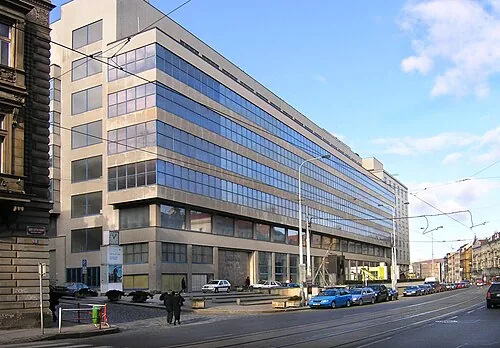
The Trade Fair Palace in Holešovice is a functionalist exhibition hall of 1928 by Oldřich Tyl and Josef Fuchs, built for trade fairs and now the National Gallery's home for modern and contemporary art. It burned out in 1974 and reopened as a gallery in 1995, and it is the largest exhibition building in the city, with seven floors arranged round a vast glazed atrium. Le Corbusier visited and admired it when it was new.
Open in the planner →Getting there
Trams 6, 12 and 17 stop at Veletržní palác, directly outside. Metro line C (red) to Vltavska leaves a five-minute walk north, and line C to Nádraží Holešovice is about ten minutes from the other direction. From Staroměstské náměstí it is twenty to twenty-five minutes by metro and tram. The site is flat, the entrance is at street level and there are lifts to every floor, so this is one of the easier large museums in Prague to get round.
What you see
Go in and look up before looking at any art: the great hall is a rectangular well of light rising the full height of the building with galleried balconies on each side, and it is the best thing in the place. The collections are arranged by period across the floors. Czech modernism is the strength — cubist painting and sculpture from the years before the First World War, the interwar avant-garde, functionalist architecture and design shown with models and furniture — and the French nineteenth and early twentieth-century holdings include impressionist and post-impressionist pictures that are better than most visitors expect to find in Prague. Upper floors carry postwar and contemporary Czech work and the temporary exhibitions, which occupy large volumes and change frequently. Allow for the fact that displays are rehung regularly, so what is on which floor shifts; take the plan at the desk.
What to pair it with
Letná and its beer garden are a short tram ride or twenty-minute walk west along the plateau, and Stromovka park lies north. The Prague Exhibition Grounds are the other near neighbour.
When to go
Weekday mornings are quiet to the point of being empty. Weekends fill, and the free or reduced-entry periods the National Gallery runs draw real crowds — worth knowing either way, depending on what you want. Rain is a good reason to come, since this is two hours indoors. The atrium is at its best on a bright day.
What is hard about it
The building is bigger than the collection it holds, and whole floors can feel thin; several galleries are often closed for rehanging without notice, which is the most common complaint. Two hours of concrete and polished floors is tiring, the layout is confusing for a building that looks rectilinear, and the labelling is uneven in English. Expect to find that the one work you came for is not on display — check before you go if something specific brought you. Timed tickets apply to major temporary shows.
Common questions
How long do you need at the Trade Fair Palace?
Two hours for the permanent collections at a steady pace. Add an hour if a large temporary exhibition is on.
Is this where the modern art is?
Yes. The National Gallery splits its collections across several buildings and this one holds the modern and contemporary art.
Is it suitable for wheelchairs?
Better than most Prague museums — a level entrance, lifts to all floors and wide galleries, though distances inside are long.
Nearby
- Letná ParkThe plateau above the river, with a beer garden and the metronome
- Výstaviště Exhibition GroundsThe 1891 exhibition grounds, iron and glass, half restored
- LapidariumThe original statues from the Charles Bridge and the city gates
More of the same kind
- National MuseumThe neo-Renaissance pile at the top of Wenceslas Square
- Villa MüllerAdolf Loos's 1930 house, an argument about space made in concrete
- Convent of Saint AgnesThe oldest Gothic building in Prague, now medieval art
- Museum KampaCentral European modern art in a converted mill on the island
Part of these routes
- Holešovice and LetnáFunctionalist modern art, the old exhibition grounds and the plateau with the metronome.
- The twentieth centuryCubism, functionalism, a Loos villa and a television tower: a century of arguments in buildings.
- Prague at lengthEverything the other routes cover inside the city, spread over unhurried days with a castle at the end.