Convent of Saint Agnes
The oldest Gothic building in Prague, now medieval art
- Area Staré Město
- Type Museum
- Time needed 1h 15m
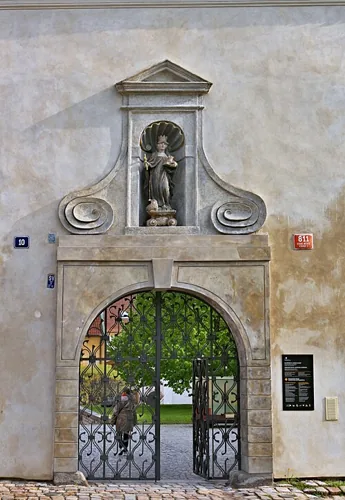
The Convent of Saint Agnes, founded in 1231 by Agnes of Bohemia, is the oldest Gothic building in Prague and sits in a quiet corner of Staré Město near the river. It was dissolved in the eighteenth century, fell into slum use, and was restored across the twentieth; it now holds the National Gallery's collection of medieval art from Bohemia and central Europe. The draw is the combination — early Gothic brick and stone cloisters with the painting and sculpture made for them.
Open in the planner →Getting there
Tram 17 to Právnická fakulta on the embankment, then three minutes inland along Rásnovka and U Milosrdných; or tram 6, 8, 15 or 26 to Dlouhá třída and a five-minute walk north. From Staroměstské náměstí it is about ten minutes on foot, through the lanes behind the Spanish Synagogue to Anežská street. It is flat all the way and the entrance is off a small courtyard that is easy to walk past.
What you see
You enter through the courtyard and the garden, which is open and free to walk in even if you skip the museum. Inside, the route takes you along the cloister walks with their plain ribbed vaults, then into the two linked churches — the Church of Saint Francis, left partly roofless and used as a concert space, and the Church of the Holy Saviour with the royal burial chapel beyond it, where the tomb slabs of the Přemyslid family are. The collection itself hangs in the upper and conventual rooms: panel paintings and altarpieces from the fourteenth century onwards, including work by the Master of the Vyšší Brod Altarpiece and the Master of Třeboň, carved wooden Madonnas and Pietas, and later Bohemian and German painting. The pieces are well lit and well labelled in English, and the stone of the building is part of the exhibition rather than a backdrop.
What to pair it with
The Spanish Synagogue and the rest of the Jewish Quarter are five minutes west, and the Rudolfinum a little further. Staroměstské náměstí with the astronomical clock is within easy walking distance to the south.
When to go
Weekday mornings are near-empty; this is one of the few central museums where you can have a room to yourself. Closed one day a week like most National Gallery buildings, so check before you go. Winter suits it, being entirely indoors apart from the garden, and the low light through the cloister windows is good then. The garden is pleasantest in late spring. The National Gallery has periodic reduced or free admission arrangements, which are worth checking but also bring the only real crowds.
What is hard about it
This is medieval religious art, room after room of panel paintings on gold grounds, and visitors who are not interested in that find it long. The cloisters are more fragmentary than complete — much of what you walk through is restoration, and the roofless church can be closed off for events or weather. Floors are uneven stone in places, lighting is deliberately low for conservation, and there is no lift to every level. Signage from the street is poor and people regularly fail to find the entrance.
Common questions
How long do you need at the Convent of Saint Agnes?
Allow about seventy-five minutes for the collection and the cloisters. Half an hour is enough if you only want the building and the garden.
Is it included with other National Gallery tickets?
The gallery sells combined admission covering several of its buildings as well as single-site entry; the arrangements change, so check at the desk or online before buying.
Is there anything to see if the museum is closed?
The courtyard and garden are normally open and free, and the exterior brickwork and north gate are the oldest Gothic fabric in the city, but the churches and collection are inside the ticketed route.
Nearby
- Charles BridgeThirty baroque statues on a fourteenth-century stone bridge
- Prague astronomical clockThe 1410 clock on the Old Town Hall, with the apostles on the hour
- Old Town SquareThe medieval square the city turns around, ringed by gabled houses
- ClementinumA Jesuit college holding a baroque library hall and an astronomical tower
- Church of Our Lady before TýnThe twin black spires over the Old Town Square
- Powder TowerThe Gothic gate where the coronation route began
More of the same kind
- National MuseumThe neo-Renaissance pile at the top of Wenceslas Square
- Villa MüllerAdolf Loos's 1930 house, an argument about space made in concrete
- Trade Fair PalaceFunctionalist hall holding the national modern art collection
- Museum KampaCentral European modern art in a converted mill on the island