Terezín
The fortress town the Nazis used as a ghetto and a transit camp
- Area Terezín
- Type Memorial
- Time needed 3h 30m
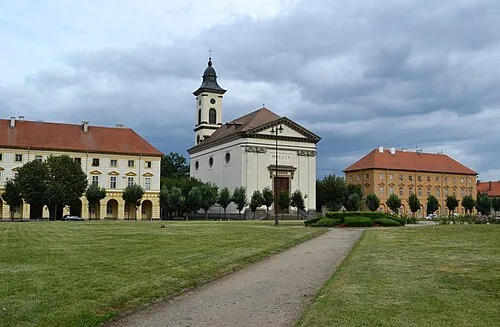
Terezín is a fortress town about 60 km north-west of Prague, built in the 1780s and used by the Nazis from 1941 to 1945 as a ghetto and a transit camp. Around 150,000 Jewish men, women and children were held here; roughly 33,000 died in the town itself, and most of the rest were deported onward, principally to Auschwitz. It is a memorial and a set of museums, spread across a working town and a separate prison fortress across the river.
Open in the planner →Getting there
Buses leave from the terminal at Prague's Nádraží Holešovice, on metro C (red), and take about an hour; services run through the day but are less frequent at weekends, and the return times matter — check them before you set out. The bus sets down in the town, within a few minutes' walk of the Ghetto Museum. The Small Fortress is on the far side of the Ohře, a walk of about fifteen minutes from the town centre along a road, past the national cemetery. Driving takes about fifty minutes from Prague.
What you see
The two main sites are separate and a walk apart, and you need both. In the town, the Ghetto Museum occupies a former school on the main square and sets out the history in documents, testimony and the drawings and poems made by children who were held here; the Magdeburg Barracks nearby show reconstructed dormitories and the ghetto's cultural life, which the SS exploited for propaganda. The streets themselves are the main square, the barrack blocks and the grid of a garrison town, now partly ordinary housing. The crematorium and the Jewish cemetery lie on the edge of the town, and the columbarium and ritual rooms are among the sites to the south. The Small Fortress, across the river, was a Gestapo prison rather than part of the ghetto: cells, isolation cells, the execution ground, the mortuary and the underground passages, kept bare. The national cemetery in front of its gate holds the graves and the mass graves. Everything is presented factually, with little commentary, and almost all of it requires reading.
What to pair it with
Litoměřice, a town of real quality three kilometres away, is the usual pairing if you want somewhere to eat and sit afterwards, and a bus connects them. Otherwise Terezín is not combined with anything — it takes the whole day and it is not a visit you tack onto something else.
When to go
Go early and allow the full day. Weekday mornings are quietest; organised coach groups from Prague arrive mid-morning and concentrate at the Small Fortress. The sites keep shorter hours in winter and some outlying parts close out of season, so check before you go. Winter is cold and exposed in the fortress, which is relevant to how long you can stand to be outside.
What is hard about it
This is a long and heavy day and should not be attempted as a casual half-day. The Small Fortress and the Ghetto Museum are two separate sites around fifteen minutes' walk apart, with more sites scattered between and beyond them, so you are on your feet for hours and much of the walking is outdoors in whatever weather there is. Reading the museum material properly takes time and is emotionally hard going; people routinely underestimate both. The town is inhabited and parts of it are run-down, which some visitors find jarring. Children under about twelve are not well served here. Food and facilities are limited, the bus service is sparser at weekends, and getting the timing of the return wrong leaves you waiting a long time. Guided tours exist and are worth considering, but the sites can also be walked alone with the museum material.
Common questions
How long do you need at Terezín?
At least three and a half hours on site, and realistically a full day once travel from Prague is counted. Allow more if you intend to read the Ghetto Museum material properly.
Are the Small Fortress and the Ghetto Museum the same place?
No. They are separate sites, on opposite sides of the Ohře, about fifteen minutes' walk apart, and a combined ticket for the memorial's sites is normally the sensible purchase.
Can you do it as a half-day trip?
Not properly. The travel alone is around two hours in total and the sites are spread out; a rushed half-day gives a misleading impression of the place.
More of the same kind
- Vyšehrad CemeteryWhere the Czech national revival buried its composers and writers
- National Monument at VítkovA granite slab on a ridge, with the largest equestrian bronze in the world
- Olšany CemeteryTwo million burials in a walled park, including Jan Palach