National Monument at Vítkov
A granite slab on a ridge, with the largest equestrian bronze in the world
- Area Žižkov
- Type Memorial
- Time needed 1h 15m
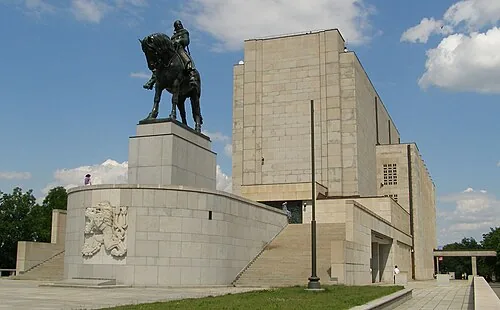
A monument of granite and bronze on the long Vítkov ridge above Žižkov, built between the wars to honour the Czechoslovak legions and finished in the 1930s. In front of it stands the equestrian statue of the Hussite commander Jan Žižka, cast in bronze and unveiled in 1950 — the largest equestrian bronze in the world. Under the communists the building was converted into a mausoleum, holding the embalmed body of President Klement Gottwald from 1953 until it was removed in 1962. The hill and the terrace are free; the interior is a ticketed museum of modern Czech statehood.
Open in the planner →Getting there
Tram 1, 9, 11 or 26 to Krejčího náměstí or Ohrada for the eastern approach, which is the gentler one, or tram 5, 8 or 26 to Těšnov and up from the Karlín side. Metro line B to Florenc leaves you at the western foot. From Staroměstské náměstí allow about 20 minutes by tram. Every approach involves a climb: the path up from Husitská in Žižkov is a steep ten minutes, and the stepped route from Karlín is steeper still. The eastern approach from Ohrada runs along the ridge almost level and is much the easiest. Once on top, the ridge path and the terrace are flat.
What you see
The ridge path brings you out onto a wide granite terrace with the statue of Žižka on his horse at its edge — vast, blunt, deliberately heavy, and best read from below the plinth rather than beside it. Behind the statue the monument itself is a slab of polished granite with bronze doors, intentionally austere. Inside, the ceremonial halls are the reason to buy a ticket: coloured marble, mosaic and bronze on a scale that no other interwar building in Prague attempts, including the hall of the legions and the central space that served as Gottwald's mausoleum. The columbarium and the basement rooms explain the mausoleum period, including the laboratory that maintained the body. The permanent exhibition covers Czechoslovak history through the twentieth century. From the terrace parapet you look west over Karlín and the river to the castle ridge, and south across the roofs of Žižkov.
What to pair it with
Žižkov spreads below the southern slope and the Žižkov television tower is visible from the terrace. Karlín and the Florenc area lie at the western foot, and Olšany Cemetery is east beyond Ohrada.
When to go
Come for the end of the afternoon: the view west towards the castle is into the light at midday and much better as the sun drops. The hill is open at all hours and the terrace is never crowded. The museum inside keeps restricted days — it is not open every day of the week — so check before you plan the interior. Winter gives the clearest air and the emptiest ridge; summer evenings bring residents up to sit on the grass.
What is hard about it
The climb is the main cost: every route up but the eastern one is steep, and there is no lift or funicular. The interior is only open on certain days and people regularly arrive to find it shut, having done the climb for nothing. The exhibition is text-heavy and the English labelling is uneven. The architecture is monumental and cold by design, which some find oppressive rather than impressive. The statue is so large that it photographs poorly from close up.
Common questions
How long do you need at the Vítkov Memorial?
About 20 minutes for the terrace, the statue and the view if you stay outside. Allow 75 minutes in total if you go into the museum and the ceremonial halls.
Is Vítkov free?
The hill, the ridge path, the terrace and the statue are free and open at any hour. Only the interior of the monument is ticketed.
Was it really used as a mausoleum?
Yes. Klement Gottwald's embalmed body was displayed in the monument from 1953 until 1962, when it was removed and cremated; the basement rooms cover that period.
Nearby
- Žižkov Television TowerA 216-metre communist-era tower with Cerny's crawling babies on it
- ŽižkovThe working-class hill district, still the city's drinking quarter
- Olšany CemeteryTwo million burials in a walled park, including Jan Palach
More of the same kind
- Vyšehrad CemeteryWhere the Czech national revival buried its composers and writers
- TerezínThe fortress town the Nazis used as a ghetto and a transit camp
Part of these routes
- Žižkov and VinohradyThe tower with the babies, the granite memorial, two great cemeteries and Plecnik's brick church.
- The hard historyThe ghetto town, the granite memorial and the cemetery where Jan Palach lies.
- Prague at lengthEverything the other routes cover inside the city, spread over unhurried days with a castle at the end.