Olšany Cemetery
Two million burials in a walled park, including Jan Palach
- Area Žižkov
- Type Memorial
- Time needed 1h
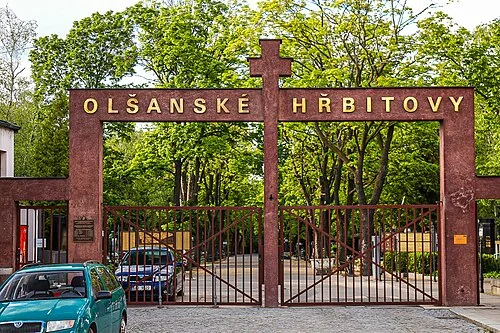
Prague's largest burial ground, founded in 1680 for plague victims and now a walled park of some two million burials spread over several linked sections in Žižkov. Jan Palach, the student who burned himself in protest at the Soviet occupation in January 1969, is buried here, and his grave is the one most visitors come to find. It is free to enter and more wooded park than cemetery once you are inside.
Open in the planner →Getting there
Metro line A to Flora or Želivského, each of which has a gate within a few minutes' walk; Želivského is nearest the eastern sections. Tram 5, 10, 11, 16 or 26 along Vinohradská stops at the same points. From Staroměstské náměstí it is about 20 minutes by metro from Muzeum. The ground is flat and the main avenues are surfaced, so walking is easy, but the cemetery is large and crossing it takes 20 minutes or more; a plan at the gate is worth a photograph before you set off.
What you see
The gates on Vinohradská open onto broad avenues of lime and chestnut, with the older sections closest to the street: nineteenth-century family tombs in stone and cast iron, chapels, and long arcaded walls of niches. Jan Palach's grave is in the newer part and is usually marked by flowers and candles — he was buried here in 1969, removed to Všetaty by the authorities in 1973, and returned to Olšany in 1990. Elsewhere there are the Soviet war graves and memorial from 1945, the Russian Orthodox section with the Church of the Dormition and its painted interior, and a Commonwealth war plot. The Jewish New Cemetery with Kafka's grave is a separate ground beyond the eastern edge, reached from Želivského. The overwhelming impression is of scale and quiet: avenues of trees, ivy, and more stone than you can take in.
What to pair it with
Žižkov lies west of the gates and the Vinohrady Water Tower is a walk in the same direction. The Jewish New Cemetery with Franz Kafka's grave adjoins the eastern side at Želivského.
When to go
Morning on a weekday is quietest and best lit, with sun down the avenues. Late autumn is the season here, both for the trees and for the first days of November, when Czech families visit their graves and the whole cemetery is lit with candles after dark — the most striking time to come, and also the busiest. It closes in the early evening and earlier in winter, so check before a late visit. Avoid it in heavy rain: there is almost no shelter.
What is hard about it
It is enormous and poorly signposted, and finding a particular grave without the location noted in advance can take a long walk. Many older sections are neglected, with collapsed stones and heavy ivy. There are few facilities inside — limited toilets, no cafe — and the gates shut earlier than you expect, particularly in winter. It is a working cemetery with funerals and mourners, so the quiet behaviour that implies is expected. Kafka's grave is not here but in the separate Jewish cemetery next door, which has its own hours, charges admission and closes on Saturdays and Jewish holidays.
Common questions
How long do you need at Olšany Cemetery?
An hour covers the main avenues, the older tombs and Palach's grave. Walking several sections properly takes two.
Is Olšany Cemetery free?
Yes, entry is free at all the public gates. The adjoining Jewish New Cemetery charges separately.
Where is Jan Palach's grave?
In the newer part of the cemetery, usually identifiable by flowers and candles. Note the section number from a plan at the gate or you will spend a while looking.
Nearby
- Žižkov Television TowerA 216-metre communist-era tower with Cerny's crawling babies on it
- ŽižkovThe working-class hill district, still the city's drinking quarter
- National Monument at VítkovA granite slab on a ridge, with the largest equestrian bronze in the world
More of the same kind
- Vyšehrad CemeteryWhere the Czech national revival buried its composers and writers
- TerezínThe fortress town the Nazis used as a ghetto and a transit camp
Part of these routes
- Žižkov and VinohradyThe tower with the babies, the granite memorial, two great cemeteries and Plecnik's brick church.
- The hard historyThe ghetto town, the granite memorial and the cemetery where Jan Palach lies.
- Prague at lengthEverything the other routes cover inside the city, spread over unhurried days with a castle at the end.