Žižkov
The working-class hill district, still the city's drinking quarter
- Area Žižkov
- Type Neighbourhood
- Time needed 1h 15m
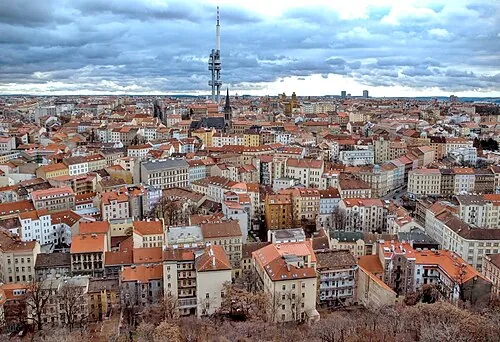
The hill district east of the main station, built for railway workers and brickmakers in the late nineteenth century and still the part of Prague with the most pubs per resident. It is not an attraction with a gate: it is a walk through steep tenement streets, with the television tower, the Vítkov ridge and the Olšany cemeteries around its edges. Come for the street life and the beer rather than for monuments.
Open in the planner →Getting there
Tram 5, 9, 15 or 26 along Husitská and Seifertova to Lipanská or Husinecká puts you in the middle of it; metro line A to Jiřího z Poděbrad sets you down at the southern edge, by the television tower. From Staroměstské náměstí it is about 15 minutes by tram from Jindřišská, or 25 minutes on foot through Nové Město and past the main station. The district climbs steeply from the station end: the streets off Husitská rise sharply, and the walk up to the Vítkov ridge or across to the tower involves real gradient. Comfortable shoes matter more here than anywhere else in the city.
What you see
Start on Seifertova or Husitská and work uphill into the grid of tenement streets — Krásova, Bolivarova, Jeseniova — where the plaster is patched, the ground floors are pubs and the views open suddenly down the hill at every junction. Small squares and strips of park break the grid. The Church of the Most Sacred Heart of Our Lord on Jiřího z Poděbrad square, Jože Plečnik's brick and granite building of 1932 with its glazed clock, is the one piece of architecture here that stands with anything in the centre. The television tower rises above the eastern streets with David Černý's crawling bronze babies on its legs. Look for the painted shop signs, the stepped alleys and the beer gardens tucked behind buildings; the district rewards wandering rather than a route.
What to pair it with
The National Monument at Vítkov sits on the ridge above the district's northern edge. Olšany Cemetery is at its eastern end, and the Žižkov television tower is at the southern end by Jiřího z Poděbrad.
When to go
Late afternoon into the evening, which is when the pubs and the street life make sense of the place. Weekday evenings are busy with residents; Friday and Saturday nights get loud and drunken, which some people come for and others should avoid. Daytime, especially Sunday morning, it is quiet to the point of being dull. Autumn and spring suit the walk; the hills are hard work in summer heat.
What is hard about it
There is nothing to see in the museum sense, and visitors who come expecting a sight find shabby streets and closed doors. Much of the fabric is run down, there is graffiti and litter in places, and the gentrified streets sit next to genuinely poor ones. The gradients are steep and relentless, with few flat routes. Late at night the pub streets can be rowdy. English is less widely spoken here than in the centre, and some older pubs are unwelcoming to outsiders.
Common questions
How long do you need in Žižkov?
About 75 minutes for a walk through the main streets. An evening spent in two or three pubs is the better use of it.
Is Žižkov safe?
Yes, in ordinary terms. It is a residential district; the usual caution about drunk crowds late at night on the pub streets applies.
What is actually worth seeing in Žižkov?
Plečnik's Church of the Most Sacred Heart on Jiřího z Poděbrad, the view from the Vítkov ridge, and the pubs. The rest is atmosphere.
Nearby
- Žižkov Television TowerA 216-metre communist-era tower with Cerny's crawling babies on it
- National Monument at VítkovA granite slab on a ridge, with the largest equestrian bronze in the world
- Olšany CemeteryTwo million burials in a walled park, including Jan Palach
More of the same kind
- JosefovThe former Jewish quarter: six synagogues and the old cemetery
- Malá StranaBaroque palaces and steep lanes between the bridge and the castle
- Nerudova StreetThe climb to the castle, lined with house signs from before street numbers
- Rašín EmbankmentThe riverside vaults and the Saturday farmers' market