House of the Black Madonna
The only cubist department store in the world, with a cubist cafe upstairs
- Area Staré Město
- Type Museum
- Time needed 50m
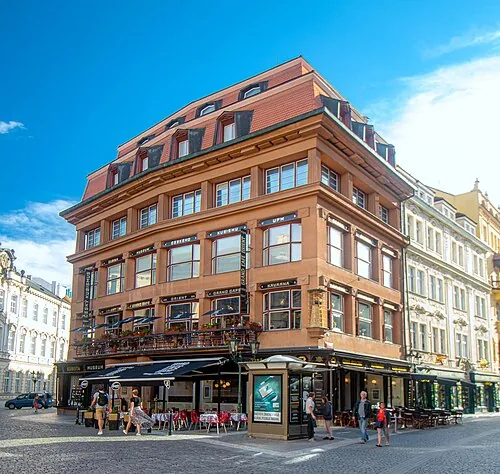
The House of the Black Madonna is a department store built by Josef Gočár in 1911-12 on the corner of Celetná and Ovocný trh, and it is generally taken as the first finished building of Czech architectural cubism. The name comes from the Baroque statue of a black Madonna on its corner, saved from the house that stood there before. Inside it holds a collection of Czech cubism, and on the first floor the Grand Cafe Orient — the only cubist cafe anywhere.
Open in the planner →Getting there
Metro line B (yellow) to Náměstí Republiky, then three or four minutes on foot west along Celetná. From the Old Town Square it is a flat five-minute walk east down Celetná and the building is on your right at the Ovocný trh junction. Metro line A at Můstek is a similar distance on the other side. The entrance is off Celetná; the cafe is reached by the internal staircase, and there is a lift in the building.
What you see
Start outside and look at what Gočár did: a reinforced concrete frame faced in brick, with the shopfront glazing and the cornices cut into angled planes, the corner marked by a railed balcony and the old Madonna set above it. Inside, the collection of Czech cubism occupies the upper floors — paintings and sculpture by the circle around Emil Filla and Otto Gutfreund, together with the furniture, ceramics, lamps and clocks that are the particular Czech contribution, objects faceted as if the cubist picture had been built in wood and glass. The staircase itself, with its angular railings, is part of the building's argument. On the first floor the Grand Cafe Orient has been put back to Gočár's design after being stripped out in the 1920s: angled light fittings, faceted mirrors, dark woodwork and chairs with cut corners. You can sit in it without a museum ticket.
What to pair it with
The Municipal House and the Powder Gate are five minutes east at Náměstí Republiky, a useful contrast of art nouveau against cubism. The Old Town Square and the Týn church are five minutes west, and the Estates Theatre is across Ovocný trh.
When to go
A weekday is best for the cafe, which fills with visitors on weekend afternoons and does not take long to reach capacity. The museum floors are rarely crowded at any time. Mid-morning light on the Celetná facade shows the brickwork and the angled cornices best. The building closes one day a week and the collection is occasionally rehung, so check before you go.
What is hard about it
It is a small museum: a couple of floors of pictures and objects, and most people are through in under an hour. The collection is a specialist one, and without some interest in early twentieth-century design it can read as a room of odd furniture. The cafe is the main draw for many visitors and is priced accordingly, service can be slow when it is full, and the reconstruction is just that — a careful remake of a lost interior rather than the original. Entry to the museum floors is ticketed separately from the cafe. The upper gallery floors are reached by stairs, though a lift is available.
Common questions
How long do you need at the House of the Black Madonna?
Forty-five minutes to an hour for the collection, and as long again if you stop in the cafe. It fits easily into a walk between the Old Town Square and Náměstí Republiky.
Do you need a ticket to visit the cafe?
No. The Grand Cafe Orient on the first floor is open to anyone, independently of the museum floors above it.
Is the cubist interior original?
The cafe was dismantled in the 1920s and rebuilt to Gočár's drawings in the 2000s, so the fittings are a reconstruction. The building's structure, staircase and facade are original.
Nearby
- Charles BridgeThirty baroque statues on a fourteenth-century stone bridge
- Prague astronomical clockThe 1410 clock on the Old Town Hall, with the apostles on the hour
- Old Town SquareThe medieval square the city turns around, ringed by gabled houses
- ClementinumA Jesuit college holding a baroque library hall and an astronomical tower
- Church of Our Lady before TýnThe twin black spires over the Old Town Square
- Powder TowerThe Gothic gate where the coronation route began
More of the same kind
- National MuseumThe neo-Renaissance pile at the top of Wenceslas Square
- Villa MüllerAdolf Loos's 1930 house, an argument about space made in concrete
- Trade Fair PalaceFunctionalist hall holding the national modern art collection
- Convent of Saint AgnesThe oldest Gothic building in Prague, now medieval art
Part of these routes
- The Old TownThe square, the clock, the two towers and the cubist corner, all within ten minutes of each other.
- The twentieth centuryCubism, functionalism, a Loos villa and a television tower: a century of arguments in buildings.
- Prague in three daysThe short list, ordered so each day holds together and the river is crossed as little as possible.
- Prague in five daysA fuller first visit: the Old Town, the castle, Malá Strana, the Jewish quarter and Vyšehrad.
- Prague at lengthEverything the other routes cover inside the city, spread over unhurried days with a castle at the end.