Lucerna Palace
An arcade of 1920s glass and marble, with a horse hanging upside down
- Area Nové Město
- Type Landmark
- Time needed 40m
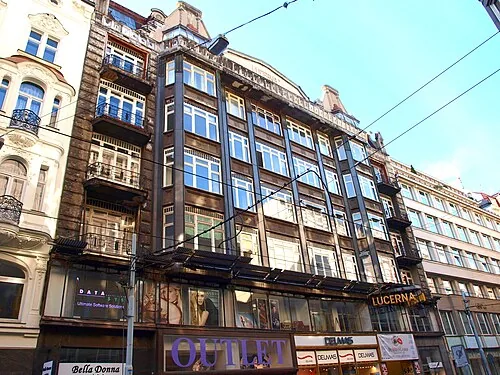
Lucerna is a working commercial arcade on Vodičkova in Nové Město, built between 1907 and 1921 by Václav Havel's grandfather, with glass roofs, marble and brass over two levels. It still functions as it was meant to: a cinema, a music bar in the basement, cafes, shops and a ballroom, all reached from the passage. The thing most people come for is David Černý's sculpture of Saint Wenceslas riding a dead horse hung upside down from the glass ceiling. Entry to the passage itself costs nothing.
Open in the planner →Getting there
Metro line A (green) or B (yellow) to Můstek, then four minutes up Wenceslas Square and left; or tram 3, 5, 6, 9, 14 or 24 to Vodičkova, which stops at the far end of the arcade. From Staroměstské náměstí it is about twelve minutes on foot via Na Příkopě. Flat throughout, though the arcade itself has steps and a short flight down to the music bar and the cinema foyer.
What you see
Go in from Vodičkova or from Štěpánská — it is a through-passage, not a dead end, and connects to the neighbouring Světozor arcade. The sculpture hangs in the stairwell void near the Štěpánská end: an upside-down horse, tongue out, with Wenceslas sitting on its belly, best seen from the balcony level looking across rather than from below. Beyond that, look at the ironwork and the curved glass canopies, the terrazzo floors, and the original lift and staircase details. The cinema retains its old auditorium and a small foyer bar on the upper floor, with a view down into the passage. Lucerna Music Bar in the basement is a long low room that runs gigs and a long-standing 1980s and 1990s video party at weekends. The Marble Hall ballroom upstairs is only open for events.
What to pair it with
Wenceslas Square and the National Museum are at the top of the street. The Mucha Museum and the Franciscan Garden are both within ten minutes, and the New Town Hall is a short walk west.
When to go
The passage is open and lit through the day and is at its best on a wet afternoon, when the glass roof earns itself. Early evening brings cinema and bar queues. The music bar's video party fills up late on Friday and Saturday and has its own door queue. Weekday mornings are quiet enough to photograph the horse without people in the frame. There is no season to avoid — it is all under cover.
What is hard about it
This is a shabby arcade rather than a restored showpiece: paint is tired, some units are empty or taken by tourist shops, and the upper floors feel neglected. The sculpture is the single reason most visitors come, and the stairwell is awkward to photograph without a wide lens. Nothing about the building is ticketed or interpreted, so there are no panels explaining what you are looking at. The ballroom is almost never open. The music bar is loud and smoky-feeling and the floor gets sticky; it is a nightclub, not a sight.
Common questions
How long do you need at Lucerna?
Twenty minutes to walk the passage and see the horse; closer to forty if you take a drink in the cinema bar or carry on into Světozor.
Do you pay to see the upside-down horse?
No. The arcade is a public passage and free to enter during the day, though the cinema, bar and ballroom are ticketed separately.
Is this the same artist as the crawling babies and the Kafka head?
Yes — David Černý, whose work is scattered around the city. The Lucerna horse is a direct answer to the upright Wenceslas statue a few hundred metres away.
Nearby
- Wenceslas SquareNot a square but a boulevard, and the stage for 1968 and 1989
- National TheatreThe gold-roofed theatre the Czechs paid for twice
- National MuseumThe neo-Renaissance pile at the top of Wenceslas Square
- Dancing HouseGehry and Milunic's curved pair on the embankment
- Charles SquareThe largest square in the city, laid out by Charles IV and now a park
- Emmaus MonasteryA Gothic abbey given two concrete spires after the 1945 bombing
More of the same kind
- Charles BridgeThirty baroque statues on a fourteenth-century stone bridge
- Prague astronomical clockThe 1410 clock on the Old Town Hall, with the apostles on the hour
- Old Town SquareThe medieval square the city turns around, ringed by gabled houses
- Golden LaneA row of tiny cottages built into the castle wall
Part of these routes
- The New TownCharles IV's fourteenth-century extension, the 1989 boulevard and the arcade with the hanging horse.
- The twentieth centuryCubism, functionalism, a Loos villa and a television tower: a century of arguments in buildings.
- Prague in five daysA fuller first visit: the Old Town, the castle, Malá Strana, the Jewish quarter and Vyšehrad.
- Prague at lengthEverything the other routes cover inside the city, spread over unhurried days with a castle at the end.