Emmaus Monastery
A Gothic abbey given two concrete spires after the 1945 bombing
- Area Nové Město
- Type Church
- Time needed 45m
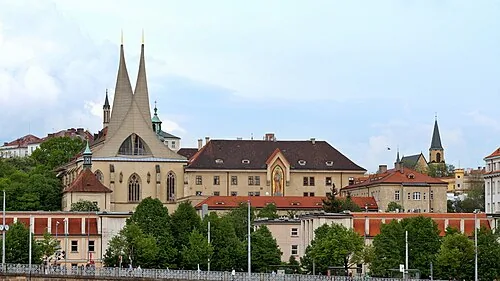
Emmaus Monastery, on a slope above the river in Nové Město, was founded by Charles IV in 1347 for Benedictines who were permitted to use the Slavonic liturgy, which is why Czechs still call it the Slavonic Monastery. Its Gothic church was gutted by a stray Allied bombing raid in February 1945 and rebuilt in 1967 with two reinforced concrete spires that curve up like wings — a deliberate modern replacement, not a restoration. The other reason to come is the cloister, which keeps a cycle of fourteenth-century wall paintings.
Open in the planner →Getting there
Metro line B (yellow) to Karlovo náměstí, then eight minutes south-east down Vyšehradská; or tram 3, 7, 16, 17 or 21 to Výtoň or Albertov and a short walk up. From Staroměstské náměstí allow about twenty-five minutes on foot or fifteen by metro and walk. The final approach is a modest uphill from the embankment, and there are steps into the complex from Vyšehradská.
What you see
The spires register from the street and from across the river, so look at them before going in; they are plain grey concrete, slim and asymmetrical in silhouette. Inside the church, the interior is a tall, swept, largely bare modern space with the Gothic shell visible around the later work, and the contrast between surviving medieval fabric and 1960s concrete is the honest subject of the visit. The cloister is the part that rewards slow looking: a square Gothic walk whose walls carry the Emmaus cycle, mid-fourteenth-century paintings of Old and New Testament scenes paired with one another, damaged, faded in places and lost in others, with explanatory boards. Off the cloister are the chapter house and smaller chapels, and the monastery garden gives you the best angle on the spires. A Benedictine community is active here again, so parts of the complex are private.
What to pair it with
The Church of Saint John of Nepomuk on the Rock is across the street, and the Botanical Garden of Charles University is just up Benátská. Vyšehrad is fifteen minutes south, and Charles Square ten minutes north.
When to go
Weekday mornings and early afternoons; opening is limited and the complex closes earlier than city-centre churches, so check before you go, and it is often shut on Sundays outside service times. The cloister paintings need daylight — a bright day between late spring and early autumn shows them far better than a dim winter afternoon. Crowds are not an issue here at any time of year.
What is hard about it
This is a quiet, half-ruined place rather than a polished attraction, and the church interior will strike some visitors as bleak. Much of the bomb damage was never made good, the wall paintings are badly worn and need patience and the boards to make sense of, and photography is restricted in places. Opening hours are short and unreliable, and services or private monastic use can close the cloister without warning. There is little in English beyond the cloister panels, and no cafe on site.
Common questions
How long do you need at Emmaus Monastery?
About forty-five minutes: the cloister paintings take most of it, with ten or fifteen minutes for the church and garden.
Why are the spires made of concrete?
The medieval towers and much of the church were destroyed by bombing on 14 February 1945. Rather than copy what was lost, the 1960s rebuilding gave the church two curved concrete spires in a frankly modern design.
Is there an admission charge?
The cloister and its paintings are a ticketed museum route; the church itself can usually be entered for prayer without charge. Check at the entrance, as the arrangements change.
Nearby
- Wenceslas SquareNot a square but a boulevard, and the stage for 1968 and 1989
- National TheatreThe gold-roofed theatre the Czechs paid for twice
- National MuseumThe neo-Renaissance pile at the top of Wenceslas Square
- Dancing HouseGehry and Milunic's curved pair on the embankment
- Lucerna PalaceAn arcade of 1920s glass and marble, with a horse hanging upside down
- Charles SquareThe largest square in the city, laid out by Charles IV and now a park
More of the same kind
- St. Vitus CathedralThe Gothic cathedral inside the castle, with the crown jewels and Mucha's window
- St. Nicholas Church (Malá Strana)The finest baroque church in the city, with a 70-metre dome
- Old New SynagogueThe oldest working synagogue in Europe, built around 1270
- Spanish SynagogueMoorish revival interior, every surface gilded and patterned
Part of these routes
- The New TownCharles IV's fourteenth-century extension, the 1989 boulevard and the arcade with the hanging horse.
- Churches and monasteriesGothic, baroque and modern, from the Hussite chapel to Plecnik's brick box.
- Prague at lengthEverything the other routes cover inside the city, spread over unhurried days with a castle at the end.