New Town Hall
Where the first defenestration of Prague happened in 1419
- Area Nové Město
- Type Landmark
- Time needed 40m
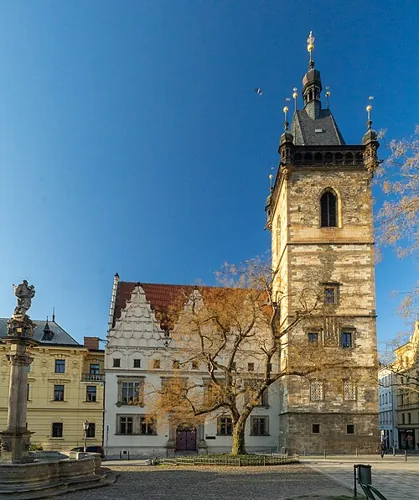
The New Town Hall stands at the northern end of Charles Square in Nové Město, built from the 1370s as the seat of Charles IV's new town. On 30 July 1419 a Hussite crowd led by Jan Želivský threw the Catholic councillors from its windows, the first defenestration of Prague and the event that started the Hussite wars. The building keeps a Gothic hall at ground level, a Renaissance gable, and a tower of 1456 that you can climb for a view down Wenceslas Square and across the New Town.
Open in the planner →Getting there
Metro line B (yellow) to Karlovo náměstí and two minutes north across the park; or tram 3, 5, 6, 9, 14 or 24 to Vodičkova, which is just east of it. From Staroměstské náměstí it is about fifteen minutes on foot down Na Příkopě and Vodičkova. The entrance is at street level on the corner of the square; the tower is about seventy metres and the climb is a narrow spiral staircase of roughly two hundred steps with no lift.
What you see
The ground floor holds two vaulted Gothic halls, plain and high, used for exhibitions, concerts and weddings; above them the first-floor hall has a wooden ceiling and the windows on the square side — these are the windows of 1419, and there is interpretation about the defenestration. Temporary exhibitions occupy the halls and vary in quality. The tower is the main draw: the stair passes a small display on the building and the Hussite period, then an old guard's chamber part way up, before coming out on a gallery under the spire. From there you look straight up Wenceslas Square to the National Museum, down over the trees of Charles Square, west to the Castle and Petřín, and over the roofs and courtyards of Nové Město, which few visitors ever see from above. There is a cafe at the top of the tower stair on some days.
What to pair it with
Charles Square itself is immediately below. Lucerna and Wenceslas Square are ten minutes east, and Emmaus Monastery a quarter of an hour south.
When to go
Tower visits are daytime and the tower closes in the colder months in some years, so check before you go. Late afternoon gives the best light looking east up Wenceslas Square; morning is better for the Castle. The tower is rarely busy at any hour — this is the uncrowded alternative to the Old Town Hall tower. Exhibitions downstairs are busiest at weekends, and the halls are closed outright when a wedding or a private event is on.
What is hard about it
The climb is the obstacle: a tight, steep, single-width spiral with no lift and limited passing places, which rules it out for many people and is uncomfortable for anyone claustrophobic. The viewing gallery is narrow and partly screened. Downstairs, what is open depends entirely on the current exhibition or event, and a private booking can shut the historic halls on the day you arrive. English interpretation is limited and the defenestration — the reason most visitors come — is covered by a few panels rather than any display worth the name. The tower and the halls may be ticketed separately.
Common questions
How long do you need at the New Town Hall?
Forty minutes is enough for the tower and a look at the Gothic halls. Add time if an exhibition interests you.
Which defenestration happened here?
The first, in 1419, when Hussites threw the town councillors out of the first-floor windows. The 1618 defenestration that triggered the Thirty Years' War took place at Prague Castle, not here.
Is the tower worth climbing if you have already done the Old Town Hall?
Yes, if you want the New Town rather than the Old — the view up Wenceslas Square is unique to this tower, and there is almost never a queue. The stairs are harder, as there is no lift.
Nearby
- Wenceslas SquareNot a square but a boulevard, and the stage for 1968 and 1989
- National TheatreThe gold-roofed theatre the Czechs paid for twice
- National MuseumThe neo-Renaissance pile at the top of Wenceslas Square
- Dancing HouseGehry and Milunic's curved pair on the embankment
- Lucerna PalaceAn arcade of 1920s glass and marble, with a horse hanging upside down
- Charles SquareThe largest square in the city, laid out by Charles IV and now a park
More of the same kind
- Charles BridgeThirty baroque statues on a fourteenth-century stone bridge
- Prague astronomical clockThe 1410 clock on the Old Town Hall, with the apostles on the hour
- Old Town SquareThe medieval square the city turns around, ringed by gabled houses
- Golden LaneA row of tiny cottages built into the castle wall
Part of these routes
- The New TownCharles IV's fourteenth-century extension, the 1989 boulevard and the arcade with the hanging horse.
- Prague in five daysA fuller first visit: the Old Town, the castle, Malá Strana, the Jewish quarter and Vyšehrad.
- Prague at lengthEverything the other routes cover inside the city, spread over unhurried days with a castle at the end.